-
What does TRUMPF manufacturing actually cover?
-
What software is used for CNC machining?
-
How do you compare edge quality on high-power laser cutters?
-
Why does TRUMPF cost more — is it actually worth it?
-
Is a TRUMPF CO2 laser the same as one used for blepharoplasty?
-
What causes bad edge quality on a laser cutter?
I'm a quality manager at a 45-person fabrication shop in Ohio. We run a TruLaser 3030, a TruLaser 5030, and a TruBend press brake. I review roughly 50 cut parts every week before they ship to customers, and I rejected about 6% of first-time deliveries in 2024 — most of those due to edge quality and tolerance issues. These are the questions I get asked most by customers, new operators, and shop owners who are trying to decide what to buy.
What does TRUMPF manufacturing actually cover?
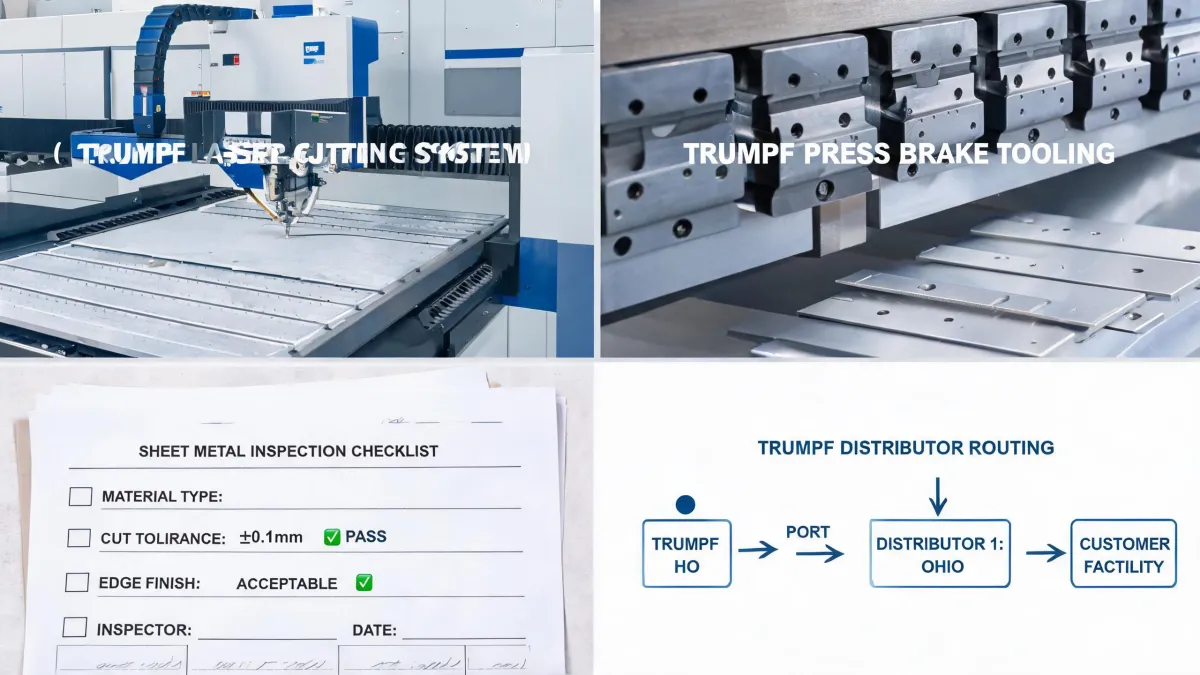
Most people assume TRUMPF is "the laser company." That's not wrong, but it's incomplete. TRUMPF manufacturing covers the full sheet metal fabrication workflow: laser cutting (TruLaser), laser welding (TruLaser Weld), marking (TruMark), press brakes (TruBend), punching (TruPunch), and metal 3D printing (TruPrint). They also build the laser sources themselves — CO2, solid-state, diode, and femtosecond — and they've been pushing hard into smart factory and Industry 4.0 software.
That breadth matters more than most buyers realize. When your laser, press brake, and programming software all come from the same manufacturer, integration is smoother, troubleshooting is simpler, and you've got one vendor to hold accountable when something goes wrong. A mixed-vendor shop can work fine — we ran one for years — but there's a real advantage to having everything speak the same language.
What software is used for CNC machining?
Short answer: it depends on whether you mean CAD, CAM, or the machine controller.
For TRUMPF machines specifically, you'll use TruTops — TRUMPF's own software suite. TruTops handles part design, nesting, programming, and connects directly to the machine. It's tightly integrated, which means you don't fight with post-processors the way you do with some generic CAM packages. Nesting is where TruTops really shines; we cut our material waste by about 12% after we migrated over.
For general CNC machining — mills and lathes, not TRUMPF equipment — the common tools are Mastercam, Fusion 360, and Siemens NX. These generate G-code from your CAD models, and each machine's controller reads that G-code and runs the toolpaths. The critical thing is having the right post-processor for your specific machine. A good post-processor is the difference between parts that match your CAM simulation and parts that cut air.
When we implemented TruTops in 2022, we had three weeks to migrate all our part programs before our old software subscription lapsed. Normally I'd want two months for a rollout like that — we had over 400 programs to convert. But with a purchase order already signed and a lease deadline, there was no time. We went with TruTops' built-in import tools and trained operators on the fly. In hindsight, I should've pushed back on the timeline. But the nesting algorithm saved us enough on material that the transition paid for itself within six months.
How do you compare edge quality on high-power laser cutters?
Edge quality isn't one measurement. It's at least four: dross on the bottom edge, average surface roughness (Ra), heat-affected zone (HAZ) size, and striation pattern consistency. ISO 9013 defines quality classes for thermal cutting, and it's genuinely worth reading before you compare machines side by side.
A few years back, we ran a trial with a competitor's 6kW fiber laser against our TruLaser 3030 — at the time, the 3030 had a 4kW CO2 source. We were cutting 12mm mild steel for a customer order. The fiber machine was faster, maybe 30% faster on thin material. But the edge quality wasn't as consistent across the full sheet. Roughly 15% of the fiber-cut parts had micro-dross that required secondary cleanup.
I knew we should've run a full production trial before committing that fiber laser to mixed-material work. But we were behind on a big order, and the supplier's demo parts looked clean. I told myself, "what are the odds it'll be that different on our material?" Well, the odds caught up with me. We ended up with a batch of 80 brackets that needed hand deburring — two days of labor and a weekend rush shipment. Now every piece of gear we evaluate goes through the same test: 50 parts, same material, same shift, measured against ISO 9013 quality class 2.
Why does TRUMPF cost more — is it actually worth it?
I'll be straight with you: we paid roughly 20% more for our TruLaser 3030 than we would have for the nearest competitor's machine. And I'd still make that call again.
Total cost of ownership is the only honest way to compare. Over seven years, our TRUMPF was down for unscheduled maintenance about three days per year. Our previous non-TRUMPF laser averaged eleven. Scrap rate dropped about 2%. Resale value held up way better than I expected — we sold our first 3030 after five years for nearly half of what we paid. When we ran the full TCO numbers, the TRUMPF was actually cheaper per part than the lower-priced alternative.
Even after we signed that purchase order, I kept second-guessing. What if the maintenance costs ballooned after year three? What if our operators struggled with the new control system? The first six months, until we had solid production data, were stressful. But the numbers kept coming in on the right side, and now I write "TRUMPF" on the spec sheet for our next machine purchase without flinching.
Is a TRUMPF CO2 laser the same as one used for blepharoplasty?
This comes up more often than you'd think, so let's clear it up: no.
TRUMPF makes CO2 lasers for industrial processing — cutting, welding, and marking metal and other materials. The CO2 lasers used in blepharoplasty (eyelid surgery) are specialized medical devices designed to ablate soft tissue with very precise, low-power pulses. They operate in completely different power ranges — milliwatts to a few watts versus kilowatts — and they have entirely different beam delivery systems and safety requirements.
TRUMPF does serve the medical industry, but as a manufacturer of surgical power tools, operating room equipment, and lasers used to make medical devices — not as a maker of surgical lasers. So no, you can't use a TruLaser 3030 for cosmetic surgery. That machine is strictly for metal.
What causes bad edge quality on a laser cutter?
When a customer sends me a photo of poor edge quality, here's what I tell them to check, in order:
- Focus position — wrong focus offset causes more edge quality issues than anything else
- Nozzle condition — a damaged nozzle or wrong nozzle size ruins edges even when everything else is perfect
- Cutting gas purity and pressure — nitrogen with even slight contamination leaves discolored, drossy edges
- Lens cleanliness — a dirty lens scatters the beam and degrades cut quality
- Material condition — rust, oil, or inconsistent coating on the sheet stock
About 70% of the edge quality problems I've seen trace back to the first three items, and the fix is cheap. Last year we rejected a run of 200 parts from our own shop before someone found a $12 nozzle with a tiny dent on the edge. Embarrassing, but fixing it brought the edge quality right back to spec. That's the thing with laser cutting — it's usually not a machine problem. It's a checklist problem.