I'm a quality/compliance manager at a contract manufacturer. Every week, I review first articles (the sample parts that verify a process before full production) and the paperwork that ships with them. In 2024, that meant roughly 2,000 line items. I rejected about 4% of first submissions. Most problems were not wild tolerance failures. They were missing material certifications, calibration dates that had expired, and inspection reports that did not match what the shop actually did.
That background has pushed me into an opinion that some sales teams dislike. I trust a supplier who says 'we don't do that' more than a supplier who says 'we can do everything.' Yes, really.
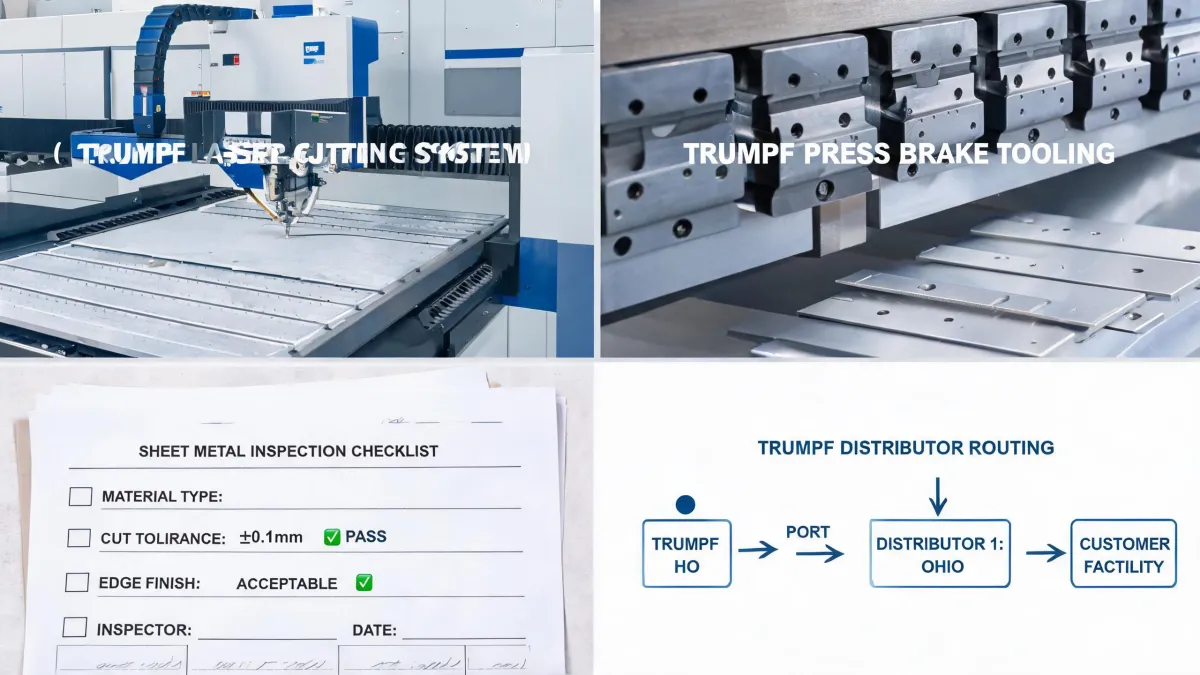
This is not an anti-TRUMPF argument. TRUMPF builds serious industrial equipment. A TRUMPF fiber laser cutting machine can hold tight cuts when it is installed correctly, maintained on schedule, and run by people who understand the process. But the machine is one input. The quality system is the other input, and I have rejected parts from shops with expensive machines because the system around the machine was weak.
A TRUMPF laser 3030 specifications sheet is a useful starting point. It tells you about work area, laser power, and rated positioning accuracy. What it does not show is the calibration schedule, the operator's training records, the nozzle inspection log, or the first-article method used after setup. Don't mistake a sales brochure from a laser cutting machine factory for the quality evidence you need.
This is where the confusion starts. The brochure answers one question: is this machine capable of making the feature? The quality system answers another: can this shop prove it made the feature correctly this time? A laser cutting machine factory knows its own machine. It does not know whether a given operator checked the lens after the 200th cut. That is up to the shop.
The One-Stop Shop Claim Is a Warning, Not a Benefit
From the outside, a vendor with cutting, welding, machining, coating, and assembly under one roof looks efficient. One PO. One invoice. One phone call. The reality is more complicated. A long list of services does not tell you which process has real controls and which one is just a machine in the corner.
Here's something vendors won't tell you: 'Sure, we can handle that' sometimes means 'we will find a subcontractor for that step halfway through the job.' I see the clue in shipping paperwork. The certificate of conformance names a facility that was never in the original quote. That is how quality defects hide.
Quality standards exist for a reason. According to ISO 9001:2015, section 8.5.1, production must occur under controlled conditions. Those conditions include documented procedures, suitable monitoring, and competent personnel. A verbal promise is not a controlled condition. If a supplier cannot show you the work instructions, the gauges, and the trained operators for each process they quoted, they have guessed at the job.
A concrete example: In the second quarter of 2024, I reviewed a 20,000-unit order from a shop that had recently added powder coating. They quoted the coating as an internal step. Midway through the run, their line went down, so they quietly sent the parts to an unapproved finisher. The adhesion test failed on 12% of the units. If they had told us before shipment, we could have audited the finisher and corrected the process. Instead, we rejected the lot and ate a three-week delay (which, honestly, hurt more than the finish failure).
When I put that incident next to our Q3 supplier results side by side, the lesson was clear. The shops that drew a line around what they truly owned had fewer rejected lots. It felt backwards at first, because the multi-process vendors looked more capable. It was not. Capability without a boundary is unmanaged risk.
What a CNC Turning Company Saint Paul MN Taught Me About Saying 'No'
One approved vendor in Saint Paul makes precision pins and shafts for us. During an urgent project, I asked if the CNC turning company Saint Paul MN could also cut a laser mounting bracket for the same assembly. They said no. Not 'we'll try.' No. They said, 'Turning is what we inspect, own, and guarantee. For the bracket, here are two shops we have already audited.'
One of those shops ran a TRUMPF fiber laser cutting machine. The first article came back clean, and the turning company followed up to confirm that the pin and bracket tolerances matched. Their boundary did not cost us the project. It made the project safer.
When Someone Asks, 'Is CO2 Laser Covered by Insurance?'
That question reaches me more often than people expect. It comes from purchasing managers, shop owners, and sometimes maintenance leads. My honest answer is a boundary: I'm not an underwriter. I cannot tell you whether your specific policy covers a CO2 laser installation without seeing that policy.
What I can tell you is what I audit during a facility visit: operator training records, interlock checks, protective housing inspections, laser safety signs, area access controls, ventilation, and maintenance logs. In my experience, insurance and safety problems are not about the wavelength. They are about vague responsibilities. One person assumes the machine builder covered the safety requirements. Another assumes the maintenance vendor did. No one owns the gap. That is a boundary problem, not a laser problem.
But What About Real Multi-Process Suppliers?
I can hear the objection: 'You are saying specialists are always safer. But someone has to own the whole assembly.' I agree. A multi-process manufacturer can be excellent. The difference is not the number of services they list. The difference is clarity of ownership.
Ask the multi-process supplier which steps are done internally and which are purchased. Ask to see the purchase specifications and receiving inspection results for the outsourced steps. If they can show them, I am comfortable. If they say, 'Don't worry, we handle everything,' that answer does not comfort me.
Here is the point I keep coming back to: a machine specification, whether from TRUMPF or any other established builder, is a description of what equipment can do under ideal conditions. Quality is what happens when people set up the job, measure the results, and catch their own mistakes before shipment.
I will end on the same note I started. A supplier who says 'this is what we do well, and this is what we don't do' is not turning work away. They are drawing a quality boundary. The supplier who promises everything gives me a list of things I need to inspect. Find me a vendor who knows the difference, and I will show you a quality system.