-
Start with total cost of ownership, not the monthly payment
-
Scenario A: You need a TRUMPF laser machine for real sheet-metal production
-
Scenario B: TRUMPF additive manufacturing and the dental industry
-
Scenario C: The IR laser vs fiber laser confusion and 30W fiber laser settings
-
How to tell which scenario applies to you
A few weeks ago, I got three different questions in the same day: Does this shop need a TRUMPF laser machine? Is TRUMPF additive manufacturing a realistic step for a dental lab? And what is the practical difference in the IR laser vs fiber laser conversation?
Those questions sound different, but they are actually the same. They all depend on your volumes, part mix, existing support structure, and how many hours the equipment will really run. I can't give a universal answer because there isn't one. What I can do is walk you through the scenarios I see most often, using the same total cost of ownership thinking I use every year when I budget and compare equipment.
Quick background so you know where I am coming from: I am a procurement manager at a 130-person machining and sheet-metal company. I've managed our equipment and tooling budget for seven years, which is roughly $800,000 a year. I also keep an invoice-level cost tracking system for every machine-related purchase. I'm not a laser engineer, but I know where the money leaks.
Start with total cost of ownership, not the monthly payment
It took me three equipment decisions and one very expensive lesson to understand that the purchase price is barely the beginning. If you compare only capital costs, you are comparing the wrong number.
The last time I ran a serious comparison for a laser cutting line, I looked at machine price, transportation, rigging, electrical work, ventilation, training, software, tooling, spare parts, service response, expected downtime cost, and resale value. I also included operator skill. That last one is the one people forget. A fancy machine operated by an undertrained team will make bad parts, and bad parts do not care how good the machine brand is.
I built a simple spreadsheet. Nothing fancy. It basically says: total cost over five years divided by expected operating hours equals cost per hour. That hourly number is what I compare between vendors. Not the sticker price.
If the machine isn't producing, the purchase price is irrelevant.
One more thing. When a sales rep says the machine is reliable, I ask for evidence. This is not being difficult. Per FTC advertising guidance, claims need substantiation, and I treat marketing claims the same way in procurement: if it is not documented, it is not a data point.
Scenario A: You need a TRUMPF laser machine for real sheet-metal production
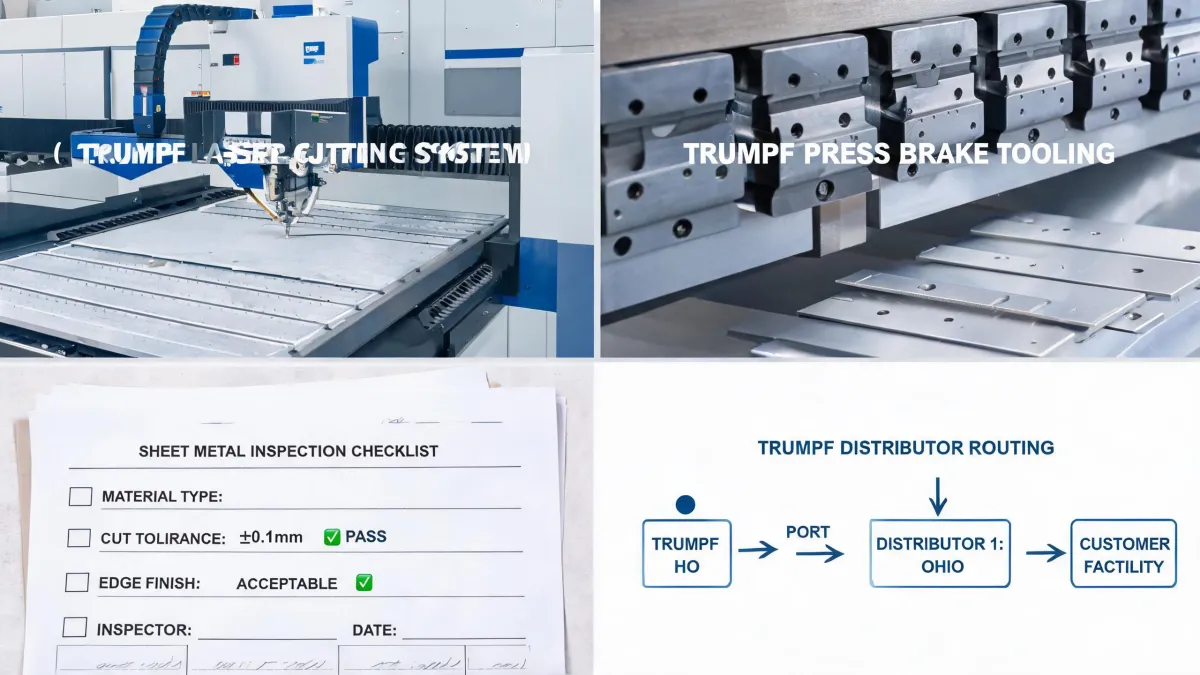
This is the clearest case for buying a TRUMPF laser machine. If you already have the work to keep a flatbed laser busy for most of a shift, or better yet, two shifts, then the discussion changes from why buy to which configuration.
The reason is not badge prestige. It is uptime and integration. TRUMPF also brings a broad portfolio that can be connected into bending and automation later. If your production plan already has steady cutting work, the higher capital cost can be spread over more operating hours. In that case, a reliable machine with strong service support usually wins on total cost per part.
But you should ignore the purchase price alone. I include a five-year service agreement in my model. Then I add an expected downtime cost based on our own historical data. Then I add programming and changeover time. In Q2 2024, I compared a quote that was initially higher than a lower-priced alternative. On the first page, the lower-priced option looked fine. On the third page, there were separate charges for setup support, remote response, and process training. Oh, and I should mention that none of those charges were hidden. They were all disclosed. But they were buried, and buried costs are still real costs.
Here is the part that goes against common thinking: don't buy capacity for future work you hope to win. Buy enough machine for the work you can forecast, and handle spikes with subcontractors. The most expensive laser machine is the one running at 20 percent utilization because someone wanted extra power for a future that didn't show up.
Scenario B: TRUMPF additive manufacturing and the dental industry
TRUMPF additive manufacturing covers a lot of industrial ground, but dental is one place where companies keep asking me whether in-house metal 3D printing makes financial sense. The honest answer is complicated.
In the 3D printing dental industry conversation, almost everyone starts with material or machine capabilities. They talk about cobalt-chrome partial denture frameworks, custom titanium abutments, design software, and build speed. Those are all important. But the procurement frame is different.
I look at powder handling, gas consumption, sieving, post-processing, quality documentation, and failed builds. Those are the cost centers that decide whether a TRUMPF additive manufacturing system pays off in a dental lab. The machine price is almost never the blocker. The blocker is everything around the machine.
Most dental labs do not keep a full-time metallurgist on staff. That's normal. But metal 3D printing requires process qualification and traceability. If a lab produces one small batch of cobalt-chrome frameworks every few days, outsourcing to a qualified service bureau may be the smarter TCO decision, even if the per-part price looks higher than the theoretical in-house cost.
I know this sounds like the opposite of the grow-your-own-capability advice you usually hear. That is kind of the point. A metal AM machine only becomes profitable when it is loaded, qualified, and producing consistently. If the current case count can't fill at least one production build on a regular schedule, buying the machine is an expensive science project.
When volume does justify it, TRUMPF's additive systems become a different equation. Then the cost per part is driven by process repeatability, powder management, and automation. At that stage, the technology is not experimental anymore. It is production capacity.
Scenario C: The IR laser vs fiber laser confusion and 30W fiber laser settings
If you are adding a marking or engraving cell, the question often gets phrased as IR laser vs fiber laser. This phrase makes my procurement ears hurt because the categories overlap.
Many fiber lasers operate at about 1064 nanometers, which is in the infrared range. So comparing IR laser vs fiber laser can be like comparing the word vehicle with the word sedan. It depends on what source the seller means by IR laser. If they mean a diode-pumped solid-state laser, then fiber can be a different source with different service life. If they simply mean the wavelength band, then a fiber laser is an IR laser.
What actually changes your total cost is not the name of the category. It is the material you need to process, the required marking depth or contrast, the duty cycle, and the quality of your local support.
For routine metal marking, a 30W fiber laser is a common and reasonable starting point. It is not magic. It still needs correct focus, clean optics, proper ventilation, and settings matched to the material. When people ask me for universal 30W fiber laser settings, I explain it differently: settings are only the last variable. The first variables are material, angle, depth, and output volume. A setting that works on one metal batch may fail on another because of coating, alloy, or surface condition.
Every time you produce a bad batch, that costs material, operator time, and rework. So don't choose a marking source based on a settings chart. Choose it based on your main materials and your tolerance for process troubleshooting. If most of your work is metal and you have steady daily volumes, fiber is usually a solid TCO choice. If most of your work is clear plastic or organic material, you need to check which wavelength actually gets absorbed rather than just comparing wattage.
How to tell which scenario applies to you
If you are trying to decide what to buy next, here is the quick way to place yourself:
- Scenario A: You already run or plan to run a flatbed laser for sheet-metal cutting most of every shift. Compare a TRUMPF laser machine against other solutions using five-year TCO and service response time.
- Scenario B: You are a dental lab with steady demand for metal dental components. Count your production builds per week first. If you cannot fill at least one build regularly, a service bureau will almost certainly beat in-house TRUMPF additive manufacturing on cost.
- Scenario C: You are adding marking or engraving, and you keep searching for 30W fiber laser settings. Stop searching for settings and start defining materials, output volume, and quality requirements. Then decide whether fiber is even the right source.
I can only speak confidently about our context: mid-size contract manufacturing with an existing maintenance team and established workflows. If you are a two-person job shop or a large enterprise with a central applications lab, your numbers will be different. That is exactly why a good equipment decision is not about finding the one correct brand. It is about finding the correct cost model for the scenario you are actually in.
Bottom line: TRUMPF equipment can be worth it, but not for every company and not in every situation. The question is not whether TRUMPF is a good machine. The question is whether your utilization, support model, and true operating cost per good part make it the best machine for you.