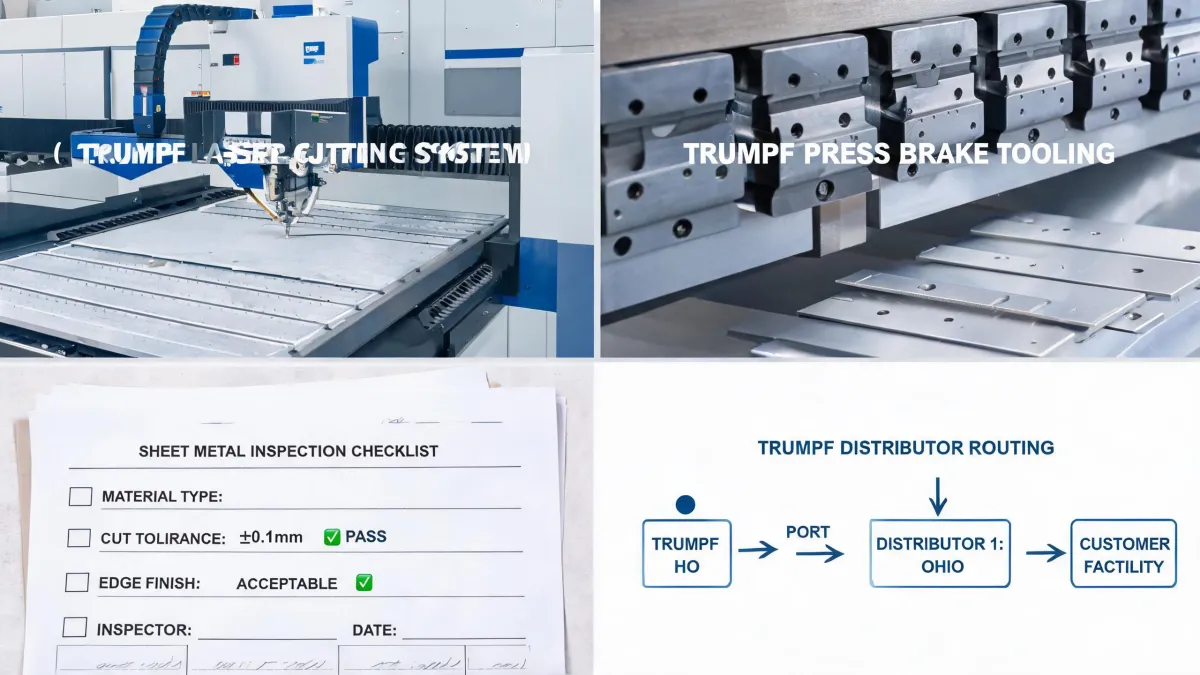
Here's an opinion that has cost me a few arguments with my own purchasing team, and I'll stand by it: the highest quote on the table is often the cheapest machine you'll ever buy. I don't mean that in a fluffy "you get what you pay for" way. I do not mean it in theory, either. The numbers work out at the end of the fiscal year. The TRUMPF fiber laser cutter price—even when it landed 20% higher than the closest competitor we evaluated—has cost us less per good part than the bargain machine we bought first.
I'm the person who gets called when everything is on fire. In my role coordinating production maintenance and equipment procurement for a mid-size metal fabrication shop, I've handled 200+ emergency situations over the last seven years. Same-day turnarounds for OEM clients. Machines down with deadlines looming. In Q4 2024 alone, we processed 47 rush orders with a 95% on-time rate.
The night that changed how I think about machine pricing was March 2023. Our first fiber laser—a budget-friendly unit we'd bought in 2021—threw a catastrophic resonator fault at 9pm, 36 hours before a $90,000 automotive order was due. Missing that deadline would have meant a $50,000 penalty clause. We had two options: find a way to cut 400 parts in 36 hours, or start calling customers to explain why we were about to lose more money than the machine was worth.
That night taught me more about equipment pricing than any evaluation spreadsheet ever did. Specifically, it taught me what "transparency" actually costs. And what it saves.
The Sticker Price Is Not the Price
When we finally replaced that machine in 2023, I built the evaluation spreadsheet I should have built two years earlier. Seventeen rows. Six vendors. Within three weeks, it was a mess—because every vendor defined "complete system" differently.
One vendor's base price looked fairly attractive. Then we added the safety enclosure. The chiller. The exhaust system. The "highly recommended for warranty" options that were mysteriously not included in the base configuration. Another quote included the cutting head but not the laser source—which is like pricing a car without an engine. A third vendor's number looked fine until we spotted the annual software licensing, billed every single year, tucked away in the fine print.
The TRUMPF quote arrived as one number. Per FTC guidelines (ftc.gov), price claims need to be truthful and not misleading—and there's a real difference between a marketing price and a ready-to-run price. TRUMPF itemized everything: laser, cutting head, chiller, control, installation, and the service agreement. The software that connects the machine to the rest of our floor was a line item we could evaluate, not a surprise that showed up in year two. The total was higher than everyone else's. But it was also real. When I signed that purchase order, I knew exactly what I was buying.
That's the transparency argument in its simplest form: a price you can trust beats a price you can't, even when the trusted number is bigger.
What the "Discounted" Machine Actually Cost Us
I'll be honest about my part in the 2021 decision: I made the classic rookie mistake of comparing sticker prices instead of operational costs. One vendor, one quote, no spreadsheet. I didn't ask what the service infrastructure looked like. I didn't ask what happened when it broke. Nine months later, I found out.
I won't name the brand, because the problem isn't one manufacturer—it's the incentive structure of quoting low and adding later. When the resonator started throwing faults, the vendor's phone number had already disconnected. Our emails bounced. We eventually reached a human through a LinkedIn page, and they quoted a $12,000 repair with a six-week lead time. Six weeks. Our jobs couldn't wait six weeks.
In an emergency, time becomes currency. We paid an independent service company $3,800 for an emergency diagnosis and a temporary patch that kept us limping along. The machine sat dead on the floor for most of that month. Here's the arithmetic:
- Initial purchase price: $187,000
- Emergency repair quote: $12,000
- Temporary external service: $3,800
- Lost revenue from jobs we couldn't quote: roughly $18,000
Total: $220,800—before counting the hours our team lost to a machine that never fully recovered. The TRUMPF TruLaser 3030 fiber laser we bought later in 2023 cost more upfront. In our shop, it has never had an unplanned outage.
Now, I won't claim TRUMPF machines "never break down." No machine deserves that claim, and any manufacturer who makes it is lying. But here's what actually happened in October 2024: a warning code appeared on our TRUMPF electric press brake (a TruBend 8000 we run for precision bending). I logged the ticket. A technician was on-site in 46 hours with the replacement part in hand. The machine was running by the next shift. That's not magic—that's a service infrastructure built for industrial production, and it's part of what you're paying for.
The Questions Buyers Forget to Ask
Every buyer asks about price, power, and cutting speed. Almost nobody asks about the things that determine real cost. Let me list the ones I've learned the hard way:
What does tooling cost per hour?
If you're coming from conventional machining, you've probably searched "what is a carbide insert" at some point. Carbide inserts are the replaceable cutting tips used in milling and turning—consumables, essentially, and their cost adds up fast over a production year. Laser cutting doesn't use inserts, but it has its own consumables: nozzles, lenses, protective windows. Ask every vendor for a per-hour consumable cost. When we compared quotes, the difference was 30%.
Are you comparing the right machines?
This sounds obvious, but people genuinely confuse equipment categories. A colleague in procurement once asked us to evaluate a "multi spindle cnc milling machine" alongside the fiber laser, as if they were alternatives. They're not. A multi-spindle CNC milling machine removes metal with rotating cutters—ideal for valve bodies, fittings, and high-volume drilling work. A fiber laser cuts and profiles sheet metal. You might need both, but you can't compare them on cost per part, because they do different operations.
Which laser are you pricing, exactly? And if you've ever searched "co2 laser for melasma before and after," you stepped into a completely different industry. Those are medical and aesthetic CO2 lasers used for skin resurfacing. Industrial CO2 lasers—the type TRUMPF built its reputation on for sheet metal processing—are another universe entirely. Same words, different machines. It's a perfect example of why "price" is meaningless without context. The question isn't "what does a laser cost?" It's "what is my application, and which machine is built for it?"
What's the response-time guarantee? This is the one nobody asks, and it's the one that matters most under pressure. What happens when your machine goes down on a Tuesday? Is a technician guaranteed within 48 hours, or are you in a queue behind every other customer in the region? Get response-time commitments in writing before you sign. If you ask me, that single line in the contract is worth more than any power specification.
The "But TRUMPF Is Expensive" Objection
I hear it from every CFO: "We can get the same thing for less." And to be fair, you can. The market is more competitive than it has ever been. There are reliable machines from solid manufacturers at almost every price point, and some shops are perfectly served by them.
But I've also watched what happens when those machines fail. Across 200+ rush situations in my career, the pattern is consistent:
- Discount vendor, urgent service: paid $800 in rush fees, waited 11 days anyway, lost the project entirely.
- TRUMPF service network: technician routed in under 48 hours, part swapped, line running by the next shift.
The most expensive machine you can buy is the one that's down when you need it.
The expensive machine looks bad in the budget review. But when everything else fails at 6pm on a Friday, the machine with the honest price and the real support infrastructure is the one still cutting parts.
Granted, not every shop needs a TRUMPF. If you're cutting light-gauge steel a few hours a week as a side operation, a simpler machine is defensible. But if this is your main revenue engine, the question isn't "what's a TRUMPF fiber laser cutter price?" It's "what exactly is that price buying me—and what will the cheaper price cost me when something goes wrong?"
The Bottom Line
I've spent seven years cleaning up after decisions made on price alone. I've seen what gets delivered at 11pm the night before a deadline, and what crumbles under the stress of an actual emergency. The industry's invisible layer of hidden fees, vague inclusions, and optimistic lead times is where real money disappears.
I still don't enjoy writing a large number on a purchase order. I do, however, trust numbers that mean what they claim to mean. These days, I ask what's not included before I ask what's included. The vendor who lists everything upfront—even when the total looks higher—is the one who costs less in the end.
We paid the "cheap" price once. It wasn't cheap. And if you're evaluating a TRUMPF fiber laser cutter price right now, my advice is simple: don't compare machines. Compare what happens when your machine is down, and choose the vendor you want on the other end of that phone call.