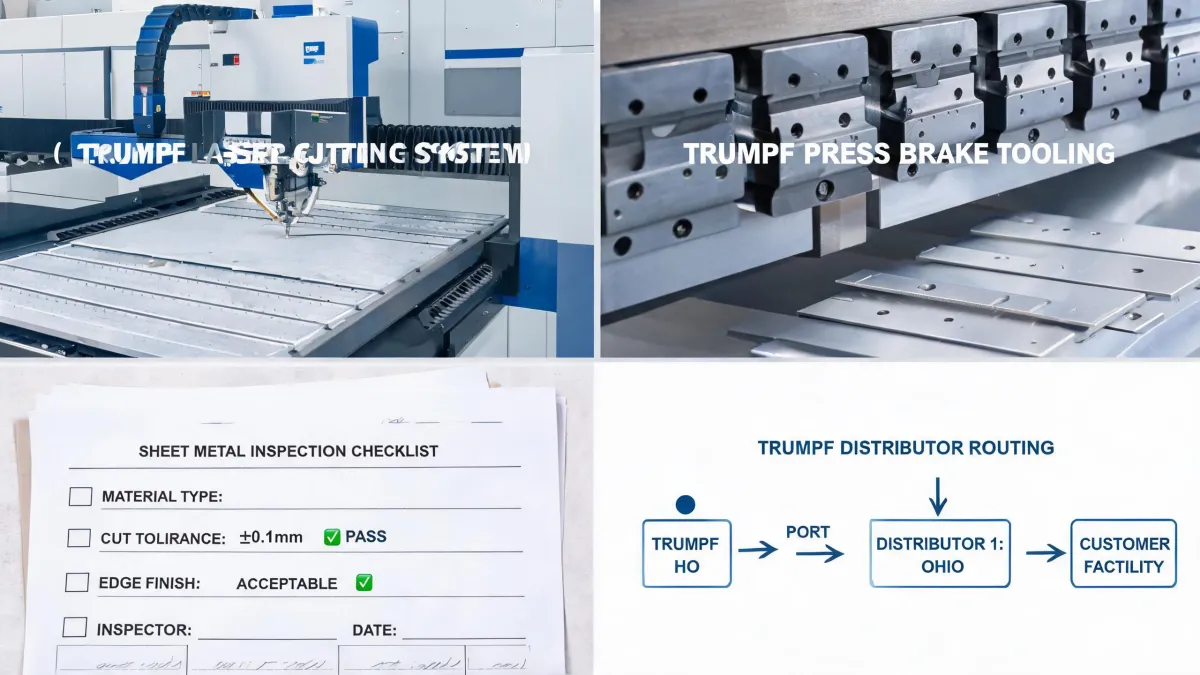
Few phone calls get my adrenaline up faster than this one: 'Should I buy a TRUMPF 5130 press brake or a TRUMPF tube laser?'
I'm a production manager at a mid-size fabrication shop. I've coordinated over 200 rush orders—actually, over 200 that I tracked; the real total is probably closer to 250. When someone calls with an emergency, I don't start with brochures. I ask one question: what is the part that has to go out the door tomorrow?
These two machines are not direct competitors. But they end up in the same buying conversation because a shop usually has one capital budget line to spend. So let's compare them the way I compare vendors: on total cost over the life of the machine, not the price on the quote.
Why These Two End Up in the Same Conversation
Both are part of TRUMPF's fabricating lineup. The 5130 is a press brake, a machine for bending sheet metal. The TRUMPF tube laser is a cutting machine for round, square, rectangular, and profile tube. Yet job shops regularly weigh these two as if they were buying 'a new capability.'
The correct question is not which one is more advanced. It's which one will process more of the parts that actually show up in your queue.
Dimension 1: The Parts They Actually Make
I got a call the other day about a stainless bracket: 3 mm thick, four bends, tolerance ±0.1 mm. On a 5130, we changed dies, loaded the program, and had a good first part in about 45 minutes. A tube laser would not have helped with that part, because it doesn't bend anything.
Flip it around. If you need 300 aluminum frames with mitered ends and sidewall holes, a press brake will sit there while the tube laser cuts every one of them. You could use a saw and a drill for that job, but not in the same time frame.
Clear conclusion: if your part mix is mostly sheet-metal brackets, boxes, and enclosures, you need the 5130. If your mix is mostly tube frames, rails, or structural pieces, you need the tube laser. It's not about which is better—it's about which part family you keep turning away.
Dimension 2: Setup and Changeover
Setup time decides a lot of rush orders. On a press brake, you change tools, adjust the backgauge, load the program, and bend a test piece. A good operator can do that quickly, but it's still a machine-side process.
On a tube laser, you import a program, load the tube, set the chuck pressure, and cut the first piece. But you may also spend time in the CAM software before you ever touch the machine. That part gets ignored in sales presentations.
What I've learned the hard way: for one-off or very small batches, the 5130 press brake usually wins. It's easier to improvise a manual bend than to re-program a laser path for a single piece of tube. For a production run of 100 identical tube parts, the tube laser wins by a mile because the programming cost is spread across the whole run.
Also: a press brake needs a skilled pair of hands. A tube laser needs someone who can read a CAD file and manage a nest. Both skills are harder to find than you'd think.
Dimension 3: Total Cost, Not Sticker Price
Sticker price is not the cost. Here's the list I use for every machine decision:
- Purchase price and rigging
- Tooling and consumables
- Programming software and training
- Maintenance and downtime
- Floor space and utilities
- Scrap and rework
- The cost of missing a promise
A shop near us bought a used press brake at auction and thought they saved money. Then they paid for custom tooling, freight, and a repair that should have been caught in a pre-purchase inspection. The apparent savings disappeared before the machine made its first production part. A TRUMPF 5130 financed with a service contract would have been the lower total cost.
Same logic applies to things like BT tool holder dimensions. If you're adding a spindle or secondary operation to a line, BT30 vs BT40 changes rigidity, tool inventory, and cycle time. It seems like a small spec, but it becomes a recurring expense.
I also worked with an injection molding shop in Salt Lake City that wanted a press brake for 'metal bits.' After mapping their part families, the actual need was laser-cut machine guards and tube frames. They almost bought the wrong machine because the price looked reasonable on paper. That's a TCO mistake.
TRUMPF publishes datasheets with footprint, power consumption, and productivity figures. Use those numbers in your model. If your quality system is ISO 9001:2015, add repeatability and calibration to the analysis too.
My honest conclusion on TCO: for most general fabricators, the 5130 press brake has lower total cost as your first TRUMPF machine because it fills a gap between cutting and painting. For a tube-processing business, the tube laser is the lower total cost because every cutting second goes into billable parts.
Dimension 4: The Rush-Order Test
Rush orders are where the total cost model stops being academic. In March 2024, a client called at 3:30 in the afternoon with a redesigned bracket that had to be at an assembly line by 7 a.m. We made it on the 5130 and delivered on time.
On the flip side, I've seen a railing contractor need 50 laser-cut tube sections for a hotel lobby installation in two days. That job goes to the tube laser, not a press brake and a cold saw.
The machine that wins the rush-order test is the one that can be set up fastest for the part that's late. If you only have one of these machines, you will say no to a lot of profitable work.
So Which One Should You Choose?
Use a simple rule:
- If more than 30% of your last 100 parts needed bending, buy the 5130 press brake first.
- If more than 30% needed tube cutting, buy the TRUMPF tube laser first.
- If you're close to 50/50, buy the one that eliminates your most expensive outsourced operation. The other becomes your second machine.
Don't buy a machine because it looks advanced. Buy it because the part you keep turning away is exactly what it makes.
And about additive manufacturing—yes, TRUMPF also makes metal 3D printers. If you only cut and bend metal, a TruPrint system is not the logical next purchase. But watch that space. If you've read about how 3D printers help sea turtles, with trackable decoy eggs built to find poaching nests, you already know additive is not a prototyping toy. It's a capability addition, not a replacement for bending and cutting.
The bottom line is total cost, not brand. TRUMPF makes excellent machines. But the right TRUMPF machine for your shop is the one that processes the parts you already sell—not the one that looks best on a spec sheet.