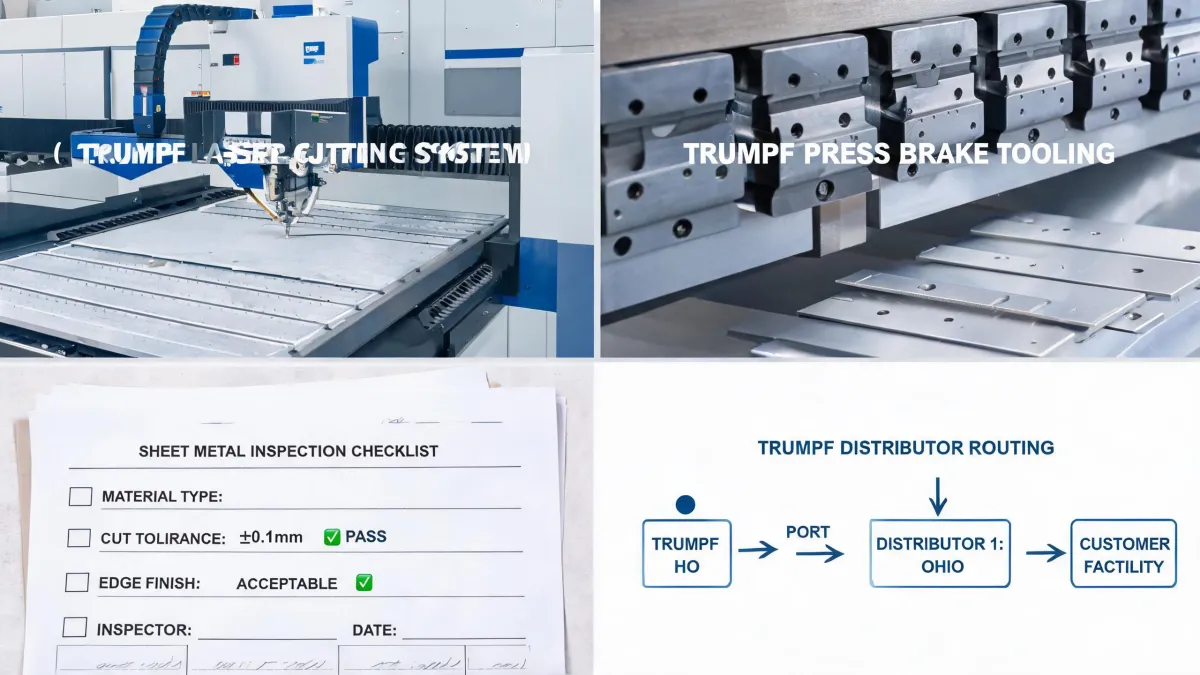
If you're evaluating TRUMPF laser cutting systems for a job shop, stop comparing maximum wattage and start asking a different question: how repeatable is the process when the same program runs 200 parts, two weeks apart? The answer is why I've kept TRUMPF machinery on our floor—even though we rejected 6% of first-article samples in our 2024 quality audit because of edge quality and documentation issues. I do not mean every part came out perfect. I mean the process was transparent enough to catch the problems before production started.
Why My Opinion Is Worth Reading
I'm a quality and compliance manager at a precision metal fabrication shop. I review every custom job before it reaches the customer—roughly 1,200 unique cut parts each quarter. Over four years of doing this, I've rejected entire batches for incorrect bend allowance, missing material certs, and edge surface issues that looked acceptable under fluorescent lighting but terrible after powder coating. In 2022, I implemented a first-article verification protocol; our customer-return rate dropped by about a third.
I'm not here to sell you a machine. I'm here to explain what I actually check when production says 'the TRUMPF is acting up.' That distinction matters.
What Actually Makes a TRUMPF Laser Cutting System Good
People often search for 'laser fibra TRUMPF' because they've heard fiber lasers are the future. They're not wrong. A TRUMPF fiber laser—like the TruLaser 3030 or 5030—is a high-absorption workhorse for cutting stainless steel, aluminum, and other reflective materials. But the laser source is only one variable in the cutting equation.
Edge quality depends on focus position, nozzle standoff, assist-gas pressure, and material condition. Cutting 3 mm mild steel with nitrogen at 8–10 bar through a 1.4 mm nozzle gives a bright edge. Drop the gas pressure to 6 bar and you'll see drag lines after powder coating. The machine didn't change. The process did.
On a TRUMPF, I can lock parameters and prove they didn't change. That's the real value. According to ISO 9013, thermal cut quality is classified by perpendicularity, roughness, and dross. I use that standard as a checklist before a batch starts, not only after a customer complains.
I also use defined color tolerances when a customer disputes a finish. According to Pantone Color Matching System guidelines, Delta E <2 is the threshold for brand-critical colors; 2–4 is noticeable to trained observers; above 4 is visible to most people. It's not a laser spec, but it's a useful reminder that 'it looks wrong' is never a useful quality metric.
TRUMPF's other quiet advantage is software. A machine that records every cut program, logs assist-gas data, and flags worn nozzles turns a quality audit from an argument into a report. In a smart factory setup, that is the difference between 'we should trust us' and 'here is the traceability.'
The Misconception That Causes the Most Waste
People think expensive vendors deliver better quality. Actually, vendors who deliver quality can charge more. The causation runs the other way. I say that not to defend high prices, but to explain why I refuse to blame the machine when the process file says otherwise.
In our Q1 2024 quality audit, we found that almost every 'laser failure' was actually a consumable or parameter change. One operator kept cutting with a scratched protective window for two shifts because it 'still cut through.' It did—until it didn't. That bad decision produced 80 parts with tapered bottom edges and a costly rework order. Another time, someone changed the feed rate on a part without logging it. The next batch passed the naked eye but failed the required edge angle. We caught it only because the machine's software kept a record.
The same diagnostic logic applies outside the shop. If you're googling 'why is my brake hard to press and car won't start,' the problem is probably not a dead engine. It's more likely a vacuum leak, a failed brake booster, or a bad master cylinder. In laser cutting, the expensive laser resonator is rarely the first thing to fail. Check the cheap stuff first: nozzle, focus, gas supply, and alignment.
Boundaries: Where I Send People Elsewhere
I'm a believer in specialization. The vendor who says 'this isn't our strength—here's who does it better' earns my trust for everything else. I'd rather work with a specialist who knows their limits than a generalist who overpromises. That applies to my own recommendations.
If you land on the TRUMPF 3D printers website, you'll see TruPrint systems for metal additive manufacturing. They're excellent, but they solve a different problem than laser cutting. A 3D printed part has different surface finish, grain structure, and lead time than a laser cut component. A website render won't tell you which process your part actually needs.
The same goes for desktop CNC. If someone asks me about Makera CNC machining parts for a low-volume prototype, I don't pretend the technology is interchangeable. A small CNC router is useful for soft metals and plastics, but it won't give you the dimensional stability of an industrial laser system over a production run. That limitation is not a criticism; it's an honest boundary.
When I Would Not Recommend a TRUMPF
A TRUMPF laser cutting system is a bad investment if you don't have the operators, maintenance discipline, and material control to feed it correctly. It's a precision instrument, not a miracle box. If you're cutting mostly wood or low-volume thin sheet, a cheaper machine will probably serve you better. I'm not anti-competitor; I'm anti-bad-fit.
I also won't promise that TRUMPF machines never break. That's not true of any industrial equipment. What I can say is that when a machine does drift, the documentation and spare-part support are strong enough to bring it back quickly. For a production floor, that predictability is the actual return on investment.
Bottom Line, With Boundaries
If you need repeatable laser cutting in a medium-to-high mix metal fabrication environment, a TRUMPF system is worth the investment—provided you invest in training, consumables, and process documentation. If you only cut a few parts a month, spend your money elsewhere and don't feel bad about it.
And if you landed here because of the brake pedal question: check the vacuum booster and brake lines first. That's free advice from someone who will never touch your car.