-
The Comparison Framework: Not Spec Sheets, but Risk
-
Trumpf Press Brake for Sale: The Brake You Can Rush
-
Trumpf Femtosecond Laser Battery Applications: More Precision Than You Might Need
-
Stainless Steel Tube Laser Cutting Machine: Dedicated or Combined?
-
CNC Fiber Laser Cutting Machine for Sale: The Price of Uptime
-
What Is a CNC Vertical Milling Machine? (And Why You Might Need One)
-
Which Should You Buy? A Decision Framework
When a customer calls at 2:30 on a Friday and asks for 40 stainless steel sleeves to ship by Monday, I do not care what the brochure says. I care which machine in the shop is going to hit the number. That is the perspective I am bringing to this article. I have handled maybe 200 rush orders since 2018. More like 180 if I count only the ones that actually shipped, but I would have to check the system. Enough to see patterns.
My experience is based on mid-sized contract manufacturing orders. If you are in high-volume gigafactory production or low-tolerance aerospace work, your numbers may look different. But the comparison framework I use is the same: Can this machine get a customer through an impossible deadline without making me lose sleep?
What was true in 2019 about buying the cheapest machine and 'just making it work' is not true in 2025. The fundamentals have not changed—machines need to cut, bend, and last. But the way we compare them has shifted. When I am triaging a rush order, I do not ask which machine has the faster rapids. I ask which machine will still work when everything else around it is going wrong.
The Comparison Framework: Not Spec Sheets, but Risk
Every machine in the 'Trumpf for sale' search result has a technical specification. What you will rarely see in the listing is the machine's behavior under pressure. The brochure says 'high dynamic performance.' What I mean is: can it hold tolerance while producing a part that is already late? That's harder to measure than horsepower.
So I compare equipment on three things:
- Repeatability in chaos — can the machine still quote, cut, and bend accurately when the operator is tired and the job is late?
- Service response — how fast can someone local fix it, and can you get replacement parts without buying a plane ticket?
- Resale reality — in 2025, a machine with strong resale value is effectively a cheaper machine.
Trumpf Press Brake for Sale: The Brake You Can Rush
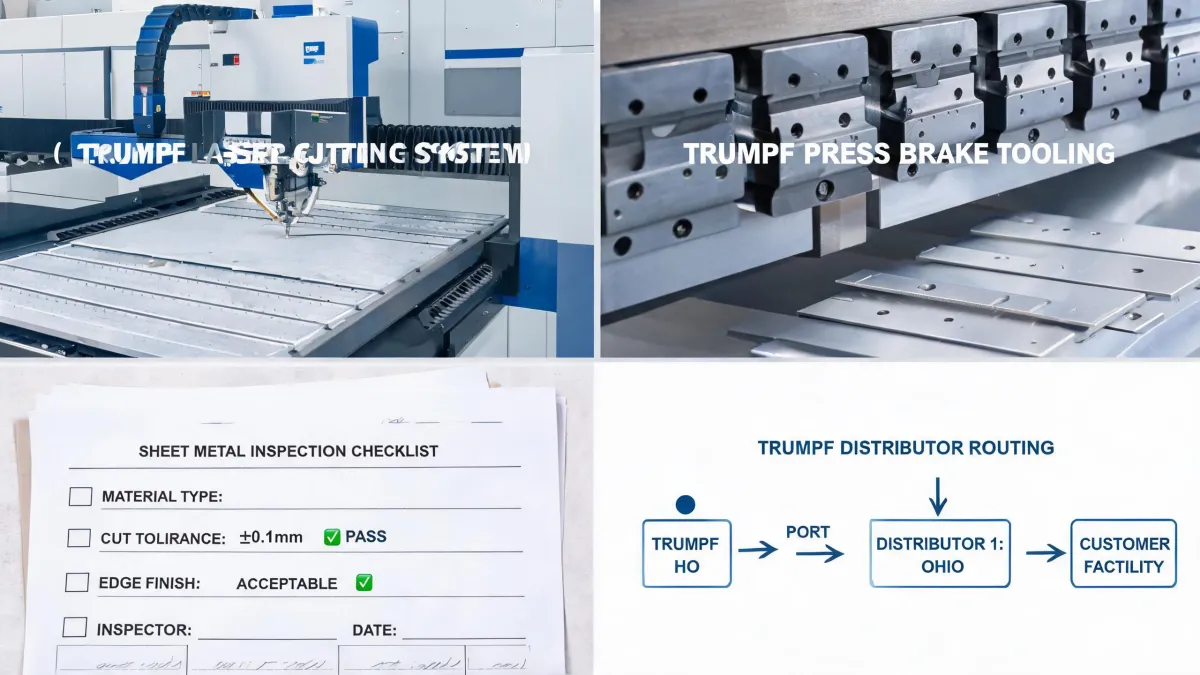
Search 'Trumpf press brake for sale' and you will see angle, tonnage, and bending length. Those are relevant. But from an emergency standpoint, the TruBend's real advantage is its control over the bending process, not the tonnage. Take a typical 1/8-inch stainless part. On a standard press brake, the operator might compensate for springback manually. On a TruBend, the angle measuring system is reading the actual angle in real time and adjusting automatically. For a rush order, that means we do not run three sample bends, stop, measure, adjust, and rerun. We run the first part in tolerance.
Honestly, I almost did not recommend a Trumpf press brake the last time we expanded. The upfront price was nearly three times a comparable budget import brake. And a good operator can make a cheap brake produce good parts. What he cannot do is guarantee the same good parts on the second shift while we are juggling a quoted lead time of 36 hours. The machine that cannot hold angle is not a machine; it is a bet.
The surprise was not the bending quality. It was service. We lost a $60,000 job once because a non-Trumpf press brake had a stuck hydraulic valve and the vendor's response was 'Tuesday.' No, wait—it was 'Thursday.' I mix it up because we had already called Trumpf service about a preventive maintenance issue and they had a truck there the next morning. Since then, every equipment purchase starts with the same question: who answers the phone on a Friday at 4pm?
Trumpf Femtosecond Laser Battery Applications: More Precision Than You Might Need
If you have looked up 'Trumpf femtosecond laser battery,' you are likely researching cutting, drilling, or patterning battery foils. This is a different world from standard laser cutting. According to TRUMPF's published TruMicro family specs, the pulse lengths fall in the ultrashort femtosecond range. That means material is removed before heat has much time to spread into the surrounding area. For battery electrodes, that can translate into less heat-affected zone, cleaner edges, fewer burrs, and less stress on nearby separator material.
But the counterintuitive part: not every battery application needs femtosecond. I have watched more than one manufacturer pay for cold-ablation performance when a green pulsed laser or a nanosecond fiber laser would have passed the customer's tolerance. If you are cutting aluminum pouches or trimming thin foils with generous quality limits, a nanosecond laser is dramatically cheaper and easier to maintain. The Trumpf femtosecond laser makes sense when the acceptance criteria explicitly say 'no recast layer' or 'no burr above a specific micron limit.'
My experience with femtosecond lasers is narrower than my experience with cutting and bending. I have run qualification samples on a TruMicro in a lab and worked with a battery cell prototype team, but I have not managed a high-volume gigafactory line. What I can tell you is this: do not let a keyword search pull you into a femtosecond laser because 'battery' sounds advanced. Compare heat-affected zone requirements first.
Stainless Steel Tube Laser Cutting Machine: Dedicated or Combined?
A 'stainless steel tube laser cutting machine' can mean two very different things. One is a dedicated tube laser with a rotating chuck and controlled support along the cut path. The other is a flatbed CNC fiber laser with a rotary attachment that gives you round tube capacity on the side.
If your business is anything like mine—mixed orders and Saturday deadlines—the choice comes down to how many times per week you switch between flat sheet and tube. A dedicated tube laser is more productive when you are cutting stainless square tube, round tube, and channel profiles in batches. It runs long parts, keeps the cut path stable, and reduces the chance of the tube shifting before the final cut. A flatbed with a rotary device can do some of that, but you will pay for it every changeover.
What often surprises people is the reverse: for smaller shops, a CNC fiber laser cutting machine with a rotary attachment might be the smarter first purchase. The reason is not cutting speed. It is utilization. If you run tubes once or twice a week, the setup time of a dedicated machine will hurt more than it helps. But if you are taking tube-only jobs with 48-hour lead times, a dedicated machine is what keeps the customer from calling a competitor.
CNC Fiber Laser Cutting Machine for Sale: The Price of Uptime
Search 'CNC fiber laser cutting machine for sale' and you will see prices ranging from under $80,000 to well over $500,000. I have personally quoted both ends. A budget 6kW fiber laser might cut half-inch stainless at a speed that is within 10 to 15 percent of a Trumpf TruLaser. On paper, the choice honestly does not look that hard. That is the trap.
The real difference appears in month eight, when a mirror loses its coating or the laser source needs a component replaced. On some machines, that component has a one-week lead time. On a Trumpf, depending on geography, there is often a local spare parts warehouse and a technician who has seen the exact model before. What is that worth? In my case, it was worth about $350,000 in sales over two years that would have disappeared if we had told customers their parts might be late.
I do not want to sound like a salesperson, because I am not. Trumpf machines are not invincible. We did need to replace a lens mount on a TruLaser 3030 once; it was not a 'never fails' story. But the response time was fast, and the repair documentation was clear. This is the part the price tag does not show. Also, we did not have a formal spare-parts tracking process. Cost us when a generic ceramic nozzle supplier ran out of stock. That experience triggered our current policy of keeping critical consumables on the shelf.
Bottom line: if you are buying a fiber laser, compare the total cost of ownership—including downtime and depreciation—to the upfront price. The cheap machine is basically a gamble. Trumpf equipment tends to hold value better because shop owners know they can get parts. That is not a guarantee; it is a market perception, and perception creates resale value.
What Is a CNC Vertical Milling Machine? (And Why You Might Need One)
If you are reading from the Trumpf side of the world, you might wonder why 'what is a CNC vertical milling machine' ends up in the same search trail. It is not because Trumpf makes one—they do not, at least not as a core product line. It is because a modern fabrication shop often needs both laser cutting and milling.
A CNC vertical milling machine, or VMC, is a machining center where the spindle is vertical. The cutting tool spins around the spindle axis, and the workpiece sits on a table below. The table moves in X and Y, and the spindle moves in Z. That is the basic geometry. You use it to produce slots, holes, threads, and flat surfaces—features a laser cutter cannot create because a laser only cuts through the full thickness from above.
So where does it fit in a shop with Trumpf laser cutting systems and press brakes? For emergency replacement parts, it is the difference between 'I can make this bracket' and 'I can make this bracket with a threaded mounting hole.' A laser gives you the flat profile; a VMC gives you the machined feature. They are not competitors. They are complementary.
Which Should You Buy? A Decision Framework
If you have read this far, here is the honest summary of what I have learned from about 180 rush jobs:
- Buy a Trumpf press brake if your orders routinely require tight angles, repeatability, and fast setup. It is one of the few shop-floor purchases that directly reduces stress on Friday afternoons.
- Buy a Trumpf femtosecond laser only if your battery or electronics work requires an explicit heat-affected-zone limit. Otherwise, match the laser to the tolerance, not to the search phrase.
- Buy a dedicated stainless steel tube laser cutting machine if you process tube more than half of your week. If tube is occasional, a fiber laser with a rotary attachment may be the smarter combination.
- Buy a CNC fiber laser cutting machine for sale after calculating total cost per good operating hour—not the sticker price. If you cannot calculate downtime costs, get help from someone who can.
- Buy a CNC vertical milling machine if customers ask for features you cannot make with a laser alone. A VMC is not a competitor to Trumpf; it is the part of the factory that turns a sheet metal part into a complete assembly.
The thread running through all five recommendations: do not choose a machine because a spec sheet or a price looks good. Choose it for how it behaves when Monday's deadline is breathing down your neck. That is the conversation worth having before you sign.