-
Conclusion First
-
Why You Should Listen to a Buyer, Not Just a Mechanic
-
The First Decision: What Kind of TRUMPF Laser Machine Do You Actually Need?
-
The TRUMPF Press Brake Tooling Catalog: A Compatibility Manual, Not a Price List
-
Are There 3D Printers That Print Metal? Yes. But Read This Before Buying.
-
The Confusion Around 'CO2 Laser': Medical vs. Industrial
-
What I'd Do If I Were Starting Over
-
Boundary Conditions
Conclusion First
If you're about to buy a TRUMPF laser machine, a press brake, or a metal 3D printer, stop thinking about the sticker price. Start thinking about the total cost of getting parts out the door. The machine is only the beginning. The real cost lives in tooling, consumables, training, service response, and downtime. If you don't verify those costs before signing, the list price will be fiction by the time the machine runs.
The same logic applies to the TRUMPF press brake tooling catalog. It's not a menu. It's a compatibility proof. If you treat it like a menu, you'll get tooling that looks right, fits 'almost,' and fails when you need it most.
And one more thing: not every 'CO2 laser' is industrial. If you're seeing Deka Tetra Pro CO2 laser results next to CO2 laser resurfacing Suwanee, that's medical/aesthetic equipment. Different industry. Don't mix them up.
Why You Should Listen to a Buyer, Not Just a Mechanic
I'm the procurement coordinator for a 35-person fabrication company. I manage roughly $800k in annual vendor spend across 9 to 10 suppliers. I report to both operations and finance. I've been doing this since 2020, and I process somewhere between 60 and 80 purchase orders a year.
What I don't do is operate the machinery every day. But I pay for it. I deal with the invoices, the wrong parts, the rush freight, and the 'actually, that wasn't included' conversations. That gives me a different perspective than the shop floor supervisor comparing micron specs.
My seat at the table exists because of one early mistake. I ordered 'compatible' press brake tooling instead of checking the actual TRUMPF press brake tooling catalog. The vendor said it was standard. It wasn't. The tool failed during a high-tonnage bend, damaged a tool holder, and shut down a work cell for most of a day. The parts supplier refunded a small portion, but not the labor, the overtime, or the burned delivery date.
The First Decision: What Kind of TRUMPF Laser Machine Do You Actually Need?
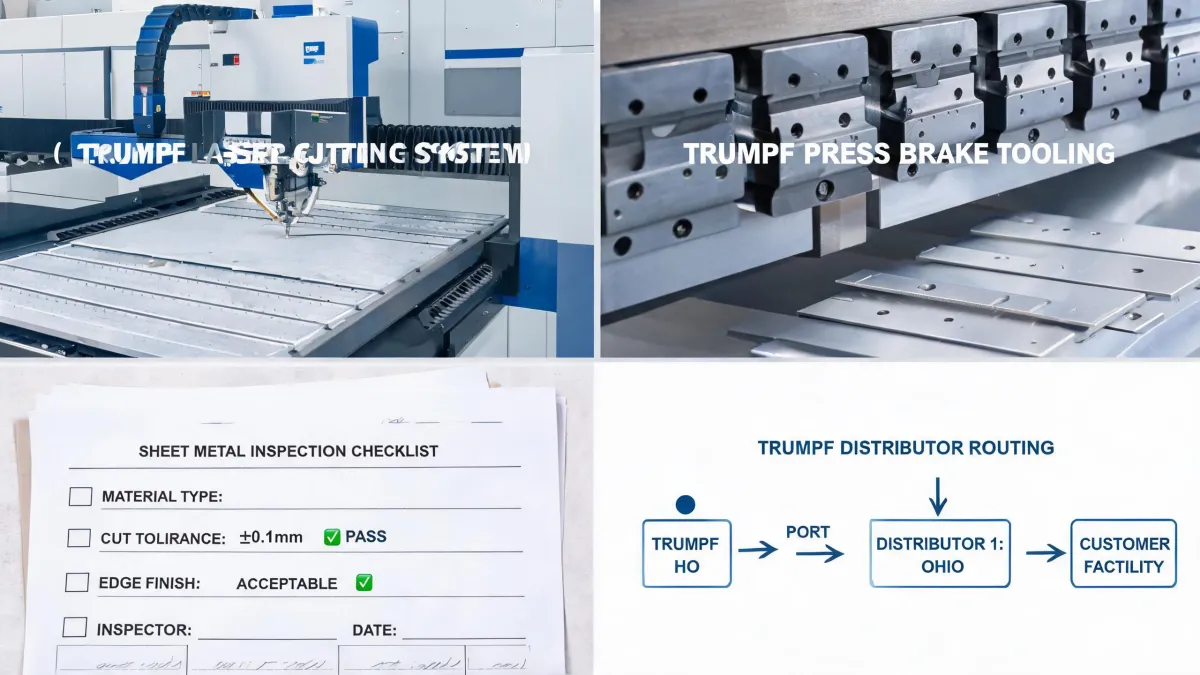
'TRUMPF laser machine' is not one product. It's a portfolio. There are cutting lasers, welding lasers, marking lasers, and lasers for additive manufacturing. A TruLaser cutting machine is not the same as a TruMark marking system. A TruDisk or TruFiber solid-state laser is different from a TruFlow CO2 laser. They use different wavelengths, different maintenance procedures, and different operator skills. I'm referencing TRUMPF's official product documentation as of January 2025; models and availability vary by region.
It's tempting to think you can compare laser machines by wattage alone. But wattage without beam quality, cutting optics, assist gas strategy, and part-handling workflow tells you almost nothing. I've watched a so-called 'lower-power' machine outperform a higher-power one on thin sheet because the setup, nesting software, and service support were better. The number on the brochure was the least important number.
So here's the process I'd use:
- List the real parts you run today, not the parts you hope to run someday.
- Ask for cycle-time estimates with your material and thickness.
- Ask for consumable cost per part, not just price per laser.
- Ask what happens when the system is down. Where is the closest service engineer? What parts are stocked locally?
That last question matters more than any other. A machine that's down for three days waiting on a part can cost more than the difference between two competing quotes.
The TRUMPF Press Brake Tooling Catalog: A Compatibility Manual, Not a Price List
If you already know the machine, the TRUMPF press brake tooling catalog is still not something to skim. The catalog defines the exact interface between the tool and the tool holder. It includes tool height, shank geometry, segment length, nose radius, bend angle, and tonnage rating. Those dimensions are not optional.
Here's where I got burned. I said the words 'compatible with our TRUMPF press brake.' The seller heard 'close enough.' What arrived was a die with the right total height but the wrong shank profile. It sat in the holder until we applied pressure. Then it shifted. We were using the same word—standard—but meaning different things. The revelation came when the machine wouldn't hold the tool securely.
If you're ordering from a third-party tooling supplier, ask for a mechanical drawing with tolerances. Not a product name. Not a photo. A drawing. If they can't provide one, move on. I know that sounds harsh. There are good third-party toolmakers, but the good ones are willing to prove compatibility on paper.
A few catalog details I now check before ordering:
- Tool height and back gauge clearance—some tools are too tall for tight flanges.
- Segment lengths that actually add up to the bed length you need.
- Rated tonnage for the die. A thin die with a sharp radius is not a heavy bending tool.
- Whether the machine uses front-loading or side-loading tool holders.
The 'save money with third-party tooling' choice can work. It can also cost more in the end. In our case, the savings were around $6,000. The damage, replacement parts, and overtime were more than that. If I remember correctly, the total hit was somewhere around $9,000, but don't quote me on the exact number. The point is the budget option wasn't budget.
Are There 3D Printers That Print Metal? Yes. But Read This Before Buying.
The direct answer to 'are there 3D printers that print metal?' is yes. TRUMPF's TruPrint series uses laser powder bed fusion to build parts layer by layer in metals like steel, aluminum, and titanium alloys. There are also directed energy deposition systems for repair and larger parts.
The bigger question is whether a metal 3D printer belongs in your facility. A metal printer is not a plug-and-play office machine. It needs argon gas, powder handling, sieving, part removal, support removal, heat treatment, and often CNC machining afterward. The powder itself is a hazard. Operators need training beyond 'click print.'
I'm not saying skip it. If you manufacture complex components with long lead times or expensive tooling, additive can be transformative. But buy it because you have a specific part family that's costing you too much. Don't buy it because 'additive is the future' or because you want to show visitors something cool. The future is expensive if it doesn't pay for itself.
The Confusion Around 'CO2 Laser': Medical vs. Industrial
This article is about TRUMPF equipment. But if you searched 'Deka Tetra Pro CO2 laser' or 'CO2 laser resurfacing Suwanee,' you probably didn't mean industrial sheet metal. That's okay. Search engines group words, not industries.
The Deka Tetra Pro CO2 laser is a fractional CO2 system used by dermatologists and medspas for skin resurfacing. It is a medical device. A CO2 laser resurfacing clinic in Suwanee might use it to treat scars, wrinkles, or skin tone. That's a completely different product category from a TRUMPF TruFlow CO2 laser, which is an industrial gas laser used for cutting and welding.
The word 'laser' is the only thing they share. If you're a medical practice, the TRUMPF press brake tooling catalog will not help you. If you're a manufacturer, a medspa's laser brochure won't help you. Make sure the search results match the application before you spend time on quotes.
What I'd Do If I Were Starting Over
If I were buying again, I'd ask 'what's NOT included?' before asking 'what's the price?' The vendor who lists everything upfront—even if the total looks higher—usually costs less in the end. That's true for machine tools, tooling, and service contracts.
I'd also insist on a written response time for service and a list of critical spare parts stocked locally. I'd check the training plan. And I'd read the compatibility catalog before signing anything, not after the tooling arrives.
That's not a guarantee you won't have problems. It's a way to make sure the problems don't surprise you.
Boundary Conditions
This advice comes from a small-to-mid-size fabrication shop in America. It may not fit if you're a large OEM buying a full production line, or a university lab doing materials research. Those situations have different financial models and different risk tolerance. If you're in healthcare or aesthetics, ignore every industrial laser sentence in this article.
I'm also not saying TRUMPF is the only equipment maker worth considering. Other excellent manufacturers exist and deserve a fair comparison. What I'm saying is this: the cheapest machine on paper is rarely the cheapest machine in operation. The same goes for tooling. Verify compatibility, count the hours, add the downtime, and then decide.