-
1. What makes the Trumpf 5130 press brake different?
-
2. Are Trumpf laser cutting machines worth the premium?
-
3. What does metal diaphragm laser cutting cost in San Bernardino, CA?
-
4. What's the most expensive 'bargain' I've paid for?
-
5. What do customers get wrong when requesting laser cutting work?
-
6. IPL laser vs CO2 laser: what's the difference?
-
7. CO2 laser or Morpheus 8: which is better?
Trumpf 5130 Press Brake & Laser Cutting FAQ: What 8 Years in San Bernardino Taught Me
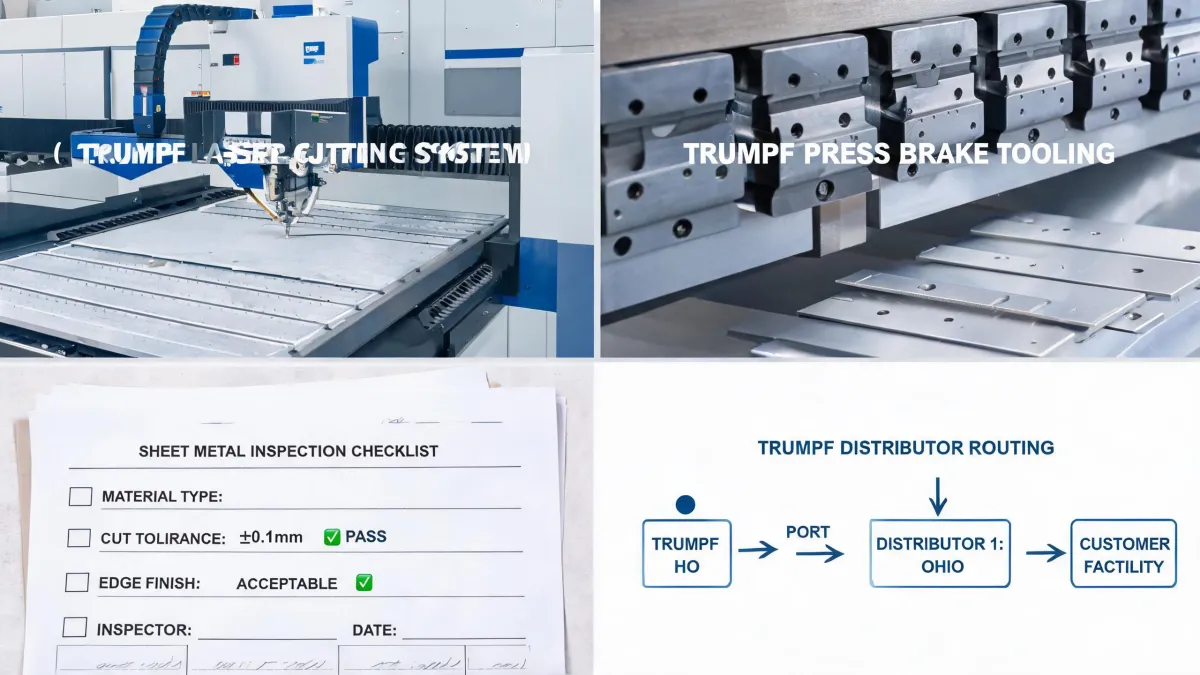
I've been handling custom metal fabrication orders in San Bernardino, CA for eight years. On the floor, that means laser cutting on a Trumpf TruLaser 3030 and bending on a TruBend 5130—or as most people search it, the Trumpf 5130 press brake. I've also personally made, and documented, 14 significant mistakes, totaling roughly $32,000 in wasted budget. I maintain our team's pre-check checklist now so nobody else here repeats them.
These are the questions I keep answering in emails, in the shop, and from people who found us while researching lasers for entirely non-industrial reasons. I can't give medical advice, but I can give physics. Every answer gets the same standard I wish more vendors applied: truthful, specific, and accountable.
- What makes the Trumpf 5130 press brake different?
- Are Trumpf laser cutting machines worth the premium?
- What does metal diaphragm laser cutting cost in San Bernardino, CA?
- What's the most expensive 'bargain' I've paid for?
- What do customers get wrong when requesting laser cutting work?
- IPL laser vs CO2 laser: what's the difference?
- CO2 laser or Morpheus 8: which is better?
1. What makes the Trumpf 5130 press brake different?
We bought ours in 2021, after a cheaper used press brake nearly sank our quarter. The 5130 is a hydraulic press brake with somewhere around 135 tons of force, but tonnage is the least interesting thing about it. What makes it different is the automatic crowning system. It compensates for frame deflection during the bend, so you don't spend hours hand-shimming dies to get a straight part across a 4-foot length. The machine adjusts for you.
The backgauge is the second thing. On our old machine, changing backstop positions meant cranking handles and double-checking with a tape measure. On the 5130, you type in the measurement and it moves. Sounds trivial. It saves minutes per setup, and minutes every setup turn into hours every week.
Then there's repeatability. Set up a job on Monday, run the last piece on Friday, and it matches the first. The old press brake would drift: first 50 brackets fine, last 80 a millimeter off. The 5130 doesn't drift like that. We logged somewhere north of 1,500 hours on it last year, and the worst unplanned stop was a hydraulic hose that took a couple hours to replace. The detailed math is in question 4, but here's the summary: yes, it was worth the price.
2. Are Trumpf laser cutting machines worth the premium?
If Google sent you here from 'macchine taglio laser trumpf,' that's Italian for Trumpf laser cutting machines. Same machines, same answer—this applies to you too.
Our TruLaser 3030 fiber laser has run nearly every working day since 2019. We cut stainless, mild steel, aluminum, and the thin nickel alloys that show up in metal diaphragm orders—mostly 304 and 316L, but also things like Hastelloy when the application demands it. We switched from an older CO2 laser to fiber, and the energy bill per part dropped noticeably. I don't have the exact percentage in front of me (it's in a utility file in the office), but the electrician who did the install commented on the difference on his own.
For us, 'worth it' comes down to uptime and support. We had a protective window fail a couple of years ago—my fault, I missed the maintenance interval—and Trumpf's service tech was on-site the next morning. We were cutting by noon. With the cheaper machine we owned before, we waited on parts and hoped the local repair guy had seen that control system before.
That said, the math isn't the same for every shop. If your laser runs two hours a day, a lighter-duty machine might be the right call. Our situation—a machine that is the heartbeat of the shop—is different. Your mileage may vary, and you should run the numbers for your own utilization.
3. What does metal diaphragm laser cutting cost in San Bernardino, CA?
I can't quote a flat price for metal diaphragm laser cutting in San Bernardino, CA without five variables: material, thickness, tolerance, quantity, and whether you need material certifications. A 0.1mm stainless diaphragm with ±0.05mm tolerance is a completely different job from a 1.5mm plate with 'just make it fit' requirements.
Here's what I can tell you: the cheapest quote is not a quote you want. Two years ago, I sent 210 stainless diaphragms to a shop that underbid everyone by 40%. They promised 'laser precision.' Their parts came back with bolt holes off by 0.015 inches (surprise, surprise). All 210 pieces scrap, $2,600 gone, and a customer phone call I'd rather forget.
For reference, a prototype run of 100 small stainless diaphragms with decent tolerances in this area usually lands in the $700–1,200 range depending on material. Our last quote for a 0.1mm 304 part was around $840—maybe $780, I'd have to pull the file. The exact number doesn't matter. A quote 40% below everybody else doesn't mean you found a bargain. It means the corners get cut on your parts.
4. What's the most expensive 'bargain' I've paid for?
Two stories, both about saving money the wrong way.
First, my first year on the job, 2017. I quoted 750 metal diaphragms as 'stainless steel' without specifying the grade. The application needed 316L for corrosion resistance; I ordered 304 because it was cheaper and in stock. The $800 saved on material turned into a $3,400 scrap write-off when the inspector pulled the mill cert and red-flagged the entire batch.
Second, the used press brake. In 2020, my gut said the used import was a gamble. The spreadsheet said it would save us $28,000 compared to the Trumpf 5130. We bought it. Eleven months and 31 days of downtime later, we had outsourced two standing orders at rush rates and the repair invoices had piled up. The $28,000 in savings became roughly $42,000 in downtime and repairs—or rather, $45,000 if you count the rush shipping. We sold it and bought the 5130.
Even after ordering the Trumpf, I kept second-guessing. Had we over-specified? Should we have looked at a mid-tier option? I didn't relax until the 5130 finished a 1,000-piece order with zero rejects. That was a good day. Our equipment checklist now includes the question 'what does downtime cost per day?'—because that number, not the purchase price, is the one that matters.
5. What do customers get wrong when requesting laser cutting work?
Three things, in order of how much pain they cause.
First, bad files. Wrong scale, missing layers, dimensions in inches sent to a metric machine. Using our pre-check checklist over the past 18 months, we've caught 47 potential errors before they became scrap—and a surprising number were unit mix-ups.
Second, 'stainless' is not a specification. '304,' '316L,' '430'—those are specifications. If you don't know what your part needs, say so. The 'what environment will this live in?' question on our checklist prevents more problems than any cutting parameter we've tuned.
Third, not telling us what the part actually does. A decorative panel and a pump diaphragm may look similar in a drawing, but the priorities are completely different. When we know a part is a diaphragm for a chemical pump, we ask about corrosion, edge finish, and pressure cycling. Generic orders get generic assumptions—and generic assumptions are how tolerances get missed. Related: 'make it like the sample.' The sample is a worn, measured, used part. A customer once told me that and the part came out wrong because we reproduced the wear. We now ask for drawings, not samples.
6. IPL laser vs CO2 laser: what's the difference?
Two sentences. An IPL device is not a laser. IPL—intense pulsed light—fires a broad spectrum of light through a filter, while a CO2 laser emits a single wavelength at 10.6 micrometers. That's the same kind of beam that cuts steel in our shop and resurfaced skin in a clinic.
Put another way: a CO2 laser is a focused, single-frequency beam. IPL is a broad floodlight with the wavelengths you don't want filtered out. They're cousins in the light-device family, but 'which is better' depends entirely on the job. I'm not a dermatologist, so I can't speak to what a doctor would recommend for you. What I can say from an operator's perspective: 'IPL laser' is a misleading phrase, and a provider who uses it loosely probably isn't being precise about other things either. Whatever device ends up being the right one, laser safety standards exist for a reason—ANSI Z136.1 is the one we follow in our shop, and the same care applies anywhere else.
7. CO2 laser or Morpheus 8: which is better?
Morpheus 8 isn't a laser either. It's microneedling combined with radiofrequency energy—tiny needles create micro-injuries while RF heats deeper tissue. A CO2 laser delivers light energy that vaporizes or damages the top layer. Both are used in aesthetic medicine, but the mechanisms are not the same, and 'which is better' only makes sense once you know what you're treating.
Physics translation: it's like comparing our laser cutter to an induction heater. Both put energy into metal. One removes material from the surface; the other heats the inside. If a provider tells you they're essentially the same, they're either confused or hoping you won't ask.
And since this is the internet: per FTC guidelines (ftc.gov), claims about what a device can do have to be truthful and substantiated. Ask for the evidence before you pay for anything. That's the same standard I apply to every machine I've bought—sometimes the hard way.