I manage procurement for a 140-person metal fabrication shop. That means I am the person who says 'no' to the nice-to-haves and 'yes' to the things that actually make payroll. Over the past six years, I have tracked just over $1.1 million in equipment and tooling spend, negotiated with more vendors than I want to count, and built a cost tracking system that has saved us more times than I can count.
So when someone asks me for the most cost-effective Trumpf CNC option, I usually answer with another question: 'What exactly are you paying for?' And that is where most conversations go sideways.
The Surface Problem: The Sticker Price Keeps Winning
Most B2B buyers I meet are not looking for the fanciest machine. They want the cheapest one that works. That is completely normal. But the word 'works' is doing a lot of heavy lifting. I have been burned by that word.
If you have ever compared quotes for a Trumpf CNC machine or press brake tooling, you know the feeling. The first vendor gives you a clean number. The second vendor gives you a lower number. Your gut says there has to be a catch, but your budget says 'go.' So you go.
In 2023, I compared quotes for a Trumpf CNC press brake setup. One vendor's tooling package was 18% lower than the alternative. The quote even included 'free setup' (which, honestly, should have been a red flag). I knew I should ask what 'free setup' actually covered, but I thought, 'we are a serious fab shop, how bad could a punch and die mismatch be?'
Well, the odds caught up with me. The mismatch was bad enough that a production job got scrapped on a Friday night. The 'free setup' did not cover programming or test pieces. That was a $450 temporary fix plus a weekend of overtime. The cheaper tooling ended up costing more than the tooling I had dismissed as overpriced.
The Deeper Cause: Tooling Catalogs Are Spec Sheets, Not Shopping Lists
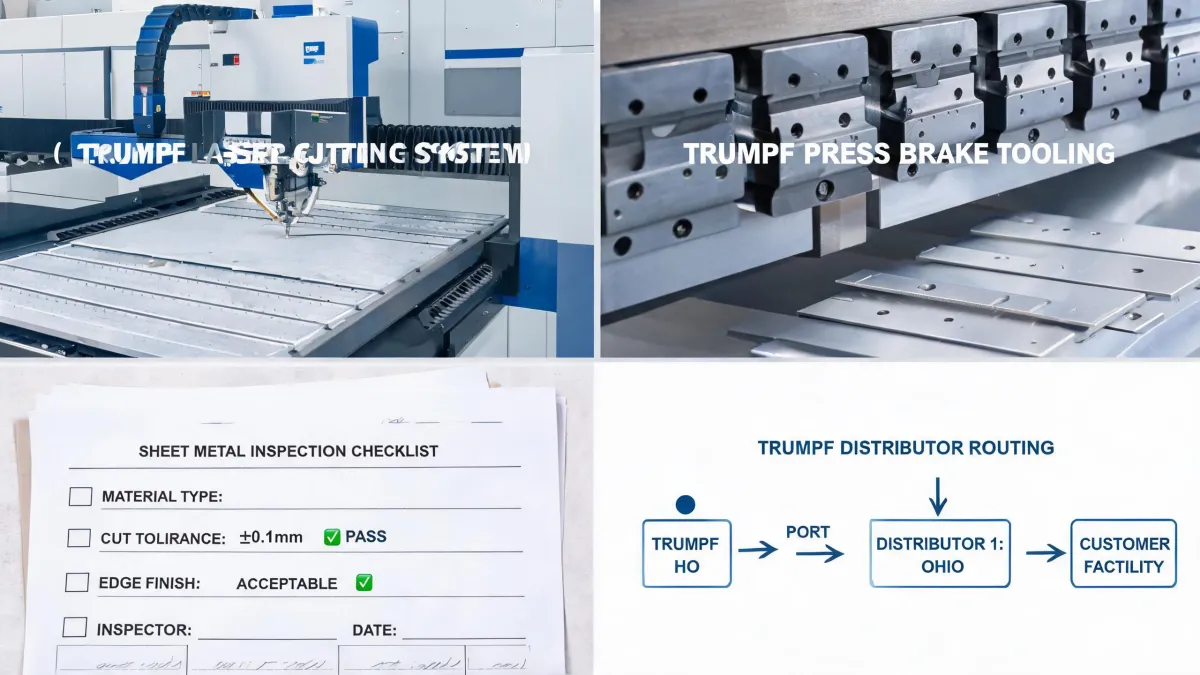
Let's get specific. The Trumpf press brake tooling catalog is a serious technical document. It is not just a price list. It contains geometry, tonnage ratings, wear limits, clamping system compatibility, and tolerances. If you treat it like an Amazon wish list and pick the cheapest punch and die pair, you are missing the point.
Tooling compatibility is a deal-breaker, not a detail. A punch with the right part number may still have the wrong profile for your material thickness. A die that works on one Trumpf CNC press brake may not work on another without the correct adapter. I am not a tooling engineer, so I cannot speak to every bend profile. What I can tell you from a procurement perspective is that the same part number can perform very differently depending on the machine, the material, and the operator. That is not a brand opinion. That is an 'I have paid for the rework' opinion.
Honestly, I am not sure why some tooling catalogs make compatibility so hard to verify. My best guess is that the manufacturers assume buyers will call before ordering, not after. But many of us do not call. We order, we receive, and then we learn. (note to self: never trust the word 'compatible' without a drawing.)
The same logic applies to an apparel laser cutter. If you are cutting custom patches or doing on-the-fly personalization, the laser source matters, but the motion control, exhaust, nesting software, and file format support matter just as much. I once watched a lower-priced system run beautifully in a demo, then choke on our production file. The vendor said it supported it, but did not mention the file needed to be pre-flattened in software we did not own. That little detail added $1,200 to the project.
The Real Cost: What Happens When We Ignore the Deep Cause
Maybe you are nodding. But if you have ever been on the fence about a 'deal' on Trumpf CNC equipment, let me show you what the hidden cost actually looks like.
- Tooling mismatch: $350 to $900 per bad setup when you count labor and scrapped material.
- Rush reorders: 25% to 40% premium on top of the original shipping cost.
- Downtime: a two-hour tooling jam on a three-shift line costs more than the tool itself.
- Rework: the 'cheap' option resulted in a $1,200 redo when quality failed. (surprise, surprise.)
Total cost of ownership includes the base machine price, setup fees, shipping and handling, rush fees, and potential redo costs. The lowest quoted price often isn't the lowest total cost.
We did not have a formal tooling verification checklist in our receiving process. That cost us the second time we saw the same 'compatible' punch from a third-party catalog arrive with the right part number but the wrong profile. The third time, I fixed the process: one page, four boxes, sign the bottom. I should have done it after the first time.
The Side Conversation: When the Answer Is Not a Trumpf Machine
Here is where I sound like the least useful supplier in the world. Some of the most common search questions I see have nothing to do with industrial metal fabrication. For example, people ask me about the best 3D printers for board game accessories. That is a completely different buying process. If you are printing a missing meeple, a custom dice tower, or a terrain set, you do not need an industrial metal 3D printer. A $300 desktop FDM printer is the right answer. I say this as someone who has a small 3D printing setup at home.
And if you are wondering how do 3D printers help dogs, the answer is actually a great procurement lesson. A friend's veterinary lab uses a desktop 3D printer to make custom leg braces for rescue dogs. They scan the dog's leg, model the brace, and print a lightweight prototype for fitment before committing to a final material. No Trumpf machine anywhere. That is the correct approach: match the machine to the requirement, not the requirement to the machine.
Small does not mean unimportant. When I was starting out, the vendors who treated my $200 orders seriously are the ones I still use for $20,000 orders. If a supplier dismisses your small job, that is a red flag, not a signal that you need a bigger budget.
The Fix, Briefly
By now the problem is clear enough that the solution does not need a sales pitch. Here is what you need to know:
- Use the official Trumpf press brake tooling catalog as a spec sheet. Check geometry, tonnage, and compatibility before you compare prices.
- Before any Trumpf CNC or laser purchase, map the full work cell: loading, cutting, nesting, cleaning, inspection. The machine is one step.
- Talk to the application engineers. They will often tell you which configuration is overkill. That is a no-brainer way to save real money.
- Get every 'included' item in writing. If a quote says setup is free, ask what the setup covers. If it says compatible, ask for the tolerance spec.
Trust me on this one. The most expensive machine is the one that does not fit your process, and the cheapest machine is the one that makes you buy everything twice. The bottom line: buy the solution, not the part number, and treat small orders like the future they can become.