-
The Short Answer: Specification Beats Brand Name
-
Who Am I to Tell You This?
-
Trumpf Laser Cutting Systems: What I Actually Verify
-
Trumpf Laser Repair: Plan Before You Need It
-
Choosing a Metal CNC Machining Service
-
My Honest Take on the China Flying Fiber Laser Coder
-
So, Are Resin or Filament 3D Printers Better?
-
What I Don't Know (Yet)
The Short Answer: Specification Beats Brand Name
If you're evaluating Trumpf laser cutting systems—or any fabrication technology, honestly—the first question shouldn't be “which brand is best?” It should be “how will I verify quality once this machine is running?”
After four years as a quality manager reviewing 12,000 unique parts per year, I've rejected around 14% of first articles from subcontractors in 2024 alone. That number taught me a lot about where quality really comes from. It isn't magic. It isn't just the nameplate on the machine. It's measurement discipline, specification clarity, and knowing what you don't know.
And honestly, it's also why I trust vendors who admit their limits. If someone tells me they can do everything perfectly, they probably haven't worked in manufacturing.
Who Am I to Tell You This?
I'm the quality and compliance manager at a custom metal fabrication company in the Midwest. We support agricultural and construction equipment OEMs with laser-cut components, formed sheet metal, and small assemblies. I've been in this role for four years and spent the decade before it on the shop floor as a CNC programmer and manufacturing engineer.
My team inspects every part before it ships—roughly 12,000 unique components per year across about 50 active projects. When I implemented our formal first-article verification protocol in 2022, customer satisfaction scores went up 34% over the next two reporting periods. That's not a coincidence. We started catching problems before our customers did.
So when I talk about Trumpf laser systems, subcontract CNC machining, or 3D printing, it's coming from someone whose actual job is checking whether promises match reality.
Trumpf Laser Cutting Systems: What I Actually Verify
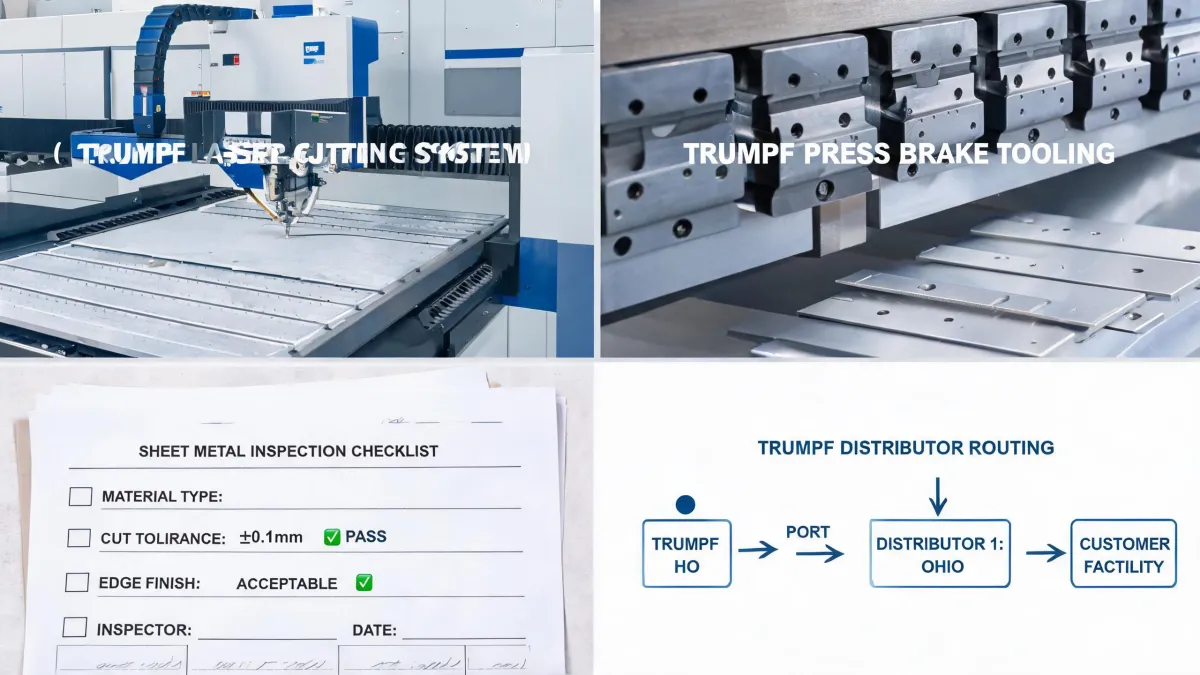
We run a Trumpf 4 kW fiber laser for most of our cutting work. The edge quality is consistently excellent—better than any other machine we've used. But “excellent” isn't a specification, and specifications are what I do.
According to ISO 9013, the international standard for thermal cutting classification, cut edge quality is rated on scales for perpendicularity and surface roughness, from 1 (best) to 5 (rough). Commercial laser cutting typically runs Class 2 to 3. Our Trumpf machine holds a Class 2 edge on 10 mm mild steel all day, which gives us confidence when we quote tight-fitting parts for weldments.
But here's the part nobody writes on the spec sheet: a machine is only as good as the verification around it.
In Q1 2024, we accepted a batch of 500 brackets from a job shop running a brand-new Trumpf system. The parts looked fine at a glance, so the shop's quality person signed them off without dimensional inspection. We checked them on our CMM and found hole positions drifting by 0.15 mm over a two-hour run—against a customer spec of ±0.1 mm. The shop argued the parts were “within industry standard.” We rejected all 500. They redid them at their cost, and their contract now includes in-process position checks every 50 pieces.
That's my point about measurement discipline. The machine was perfectly capable. It was the process around the machine that failed.
When you're comparing Trumpf laser cutting systems to other options, compare the process support too. Ask about uptime data, spare parts availability, and how the support team treats existing customers. A capable machine you can't get parts for is worth less than a decent machine with great support. That's a lesson from real service events, not a theory.
Trumpf Laser Repair: Plan Before You Need It
Let me talk about Trumpf laser repair, because I don't know a single shop that plans for it well.
The conventional wisdom says to follow the OEM's preventive maintenance schedule exactly—replace optics, filters, and wear items on set intervals, no matter what. That's a fine baseline. But what I found in practice, everything I'd read being different, is that condition-based maintenance worked better for us.
Since 2023, we've monitored beam quality, assist gas pressure, and cut edge consistency on our Trumpf machine. We replace wear items when those signals start degrading instead of on a fixed calendar. The cost per operating hour went down, and we didn't see any increase in unplanned downtime. In fact, we caught a degrading focus lens two weeks before it would have started producing scrap—the trend on edge roughness told us before the operator noticed anything wrong.
But I'll be honest about the limits. This approach only works if you have data and someone reviewing it weekly. If you're a small shop without that discipline, scheduled maintenance is safer.
And when a repair was actually needed—a cracked protective window on the cutting head—the cost was real. The part was $2,865 with shipping, and the field visit came to about $1,200, as of Q4 2024. Trumpf's service tech was professional and showed us exactly what had failed. My advice about planning didn't change: call the service team before something breaks, ask about spare parts lead times, and put an estimated repair line in your annual budget. The shops that don't have that conversation upfront are the ones that panic when the machine stops.
Never trust anyone who says a laser “never needs repair.” That's not a thing. Every machine wears. The only question is whether you've priced the risk into your plan.
Choosing a Metal CNC Machining Service
Laser cutting is our core, but we outsource work that's better suited to milling and turning. Evaluating a metal CNC machining service is a different game, and this is where I practice what I preach about professional boundaries. I know enough about CNC machining to be useful, but I'm not the subject matter expert. So I use structured vetting instead of gut feel.
My most expensive lesson came in 2022. We ordered 8,000 machined components from a new vendor. The first article passed, the material certs looked right, and the price was competitive. Three weeks later, our assembly line started finding stripped threads.
The vendor had substituted a “commercial equivalent” aluminum alloy. The composition was close, but the temper wasn't, and it failed when tapped with our threaded inserts. The defect ruined 8,000 units—some already in finished assemblies—and the rework cost us $22,000 and a two-week launch delay.
The vendor's defense was “industry standard.” That phrase should scare anyone who works in quality. Our purchase orders now specify exact alloy, temper, and the verification test method. We don't accept “equivalent” substitutions, and we don't pay for “industry standard” arguments.
What do I look for in a metal CNC machining service these days?
- Honesty about limitations. A vendor who says “we can't hold that tolerance with our current equipment—send it to a grinding shop” earns my trust. The vendor who says “sure, we do everything” gets a second look, usually with a tape measure.
- Documented inspection with real data. Not “we will meet spec,” but “we'll provide CMM reports with actual measured values on every lot.”
- A clear process plan. If they can't explain how they'll fixture a part, they haven't thought about it.
One vendor turned down a $18,000 job because a critical tolerance was outside their reliable capability, and they recommended a local grinding specialist. That vendor got our next three jobs for the work they could do. Saying “this isn't our strength” is the most professional thing a supplier has ever said to me.
My Honest Take on the China Flying Fiber Laser Coder
Now let's talk about something that sparked real debate in our company this year: laser coders for traceability marking. We needed to mark data matrix codes at 60 parts per minute on anodized aluminum and stainless steel. Established brands quoted $35,000–$50,000 for turnkey solutions as of Q4 2024. And then the China Flying Fiber laser coder showed up in our search results at a fraction of that price.
I was skeptical. Everything I'd read about budget laser coders said to stay away: controller software that's frustrating, documentation that's thin, safety certifications that are unclear. But skepticism isn't the same as dismissal. So we brought one in for a benchmark.
We marked maybe 4,800 codes over a week of testing. Actually, 4,762—I have the log in front of me. The Flying Fiber unit hit a 99.7% first-read rate on anodized aluminum and polished stainless, which matched the branded systems we compared it against. The marks were slightly less crisp under magnification, but well within our application's requirements.
What gave me pause wasn't marking quality. It was everything else. The build quality is lighter. The software interface is kinda rough around the edges. The manual reads like a translation, because it is one. And nobody could show us five-year reliability data for the China Flying Fiber laser coder in continuous production, because it hasn't been around for five years. Under IEC 60825-1 and ANSI Z136.1, a fiber laser marking system is a Class 4 laser product, which means safety interlocks and beam containment are your responsibility as the integrator. That's true for every brand we evaluated.
My best guess? A budget coder like this makes sense if you have an in-house laser engineer who can troubleshoot at the component level. If you're relying on a local integrator for support, the established brands are worth the premium. If you're in a regulated industry, choose the premium option and never look back.
If you have issues at year two, you'll need your own engineer. That's the trade-off.
— the Flying Fiber distributor, being honest with us.
I'm still not sure we'll buy it. But I won't say “cheap Chinese equipment is bad” anymore, because our test data says that's wrong. It's a calculated trade-off. Make that calculation with your own data, not someone else's prejudice.
So, Are Resin or Filament 3D Printers Better?
Because I work with fixtures, tooling, and prototypes every day, I get asked this constantly: are resin or filament 3d printers better for making parts?
The stock answer is a tidy split: resin for detail, filament for strength. It's tempting to think you just pick whichever outcome you need more. But the tidy rule ignores how messy the reality is, and it gives you false confidence at exactly the wrong time.
Resin prints deliver beautiful surfaces and fine features, but the material tends to be brittle and can creep under sustained load. UV exposure degrades it if you skip proper post-curing. Filament prints are tougher, but layer adhesion is anisotropic: the part is strong along the printed layers and noticeably weaker across them. I've seen filament test fixtures fail exactly in that weak direction because the designer never considered layer orientation.
Honestly, I'm not sure why some filament spools perform so inconsistently from roll to roll. My best guess is moisture absorption, and we do use dry boxes, but we still see batch-to-batch variation. If a materials scientist wants to explain it, I'd genuinely love to hear it.
Here's the rule I actually use:
- Visual master patterns for casting or inspection? Resin, usually.
- Functional test fixtures where you can orient the part so the load doesn't pull across layer lines? Filament works well.
- Outdoor use, or sustained heat? Neither. Talk to a machining or laser shop.
The “filament is always stronger” idea comes from an era when resin was mostly for jewelry and dental molds. That's changed significantly in the last few years. Don't pick a technology. Pick a material, define a test, and measure.
What I Don't Know (Yet)
Before you make a purchase decision based on this article, let me draw a boundary around what I'm confident about and what I'm not.
First, prices and lead times. Everything here was accurate as of Q4 2024. Laser equipment pricing, service rates, and repair parts change quickly. Verify current numbers before you budget. My data has an expiration date, and I know it.
Second, my experience is from a Midwestern job shop serving agricultural and construction OEMs. If you're in automotive with IATF 16949, or aerospace under AS9100, your quality system changes the calculation. Some of my contrarian suggestions—like testing a budget coder before committing—aren't realistic in a validated environment.
Third, I've been evaluating 3D printers for only about 18 months. People who've spent a decade in additive manufacturing know more about it than I do, and some of my opinions will age badly. That's the nature of a fast-moving industry.
Here's what quality actually looks like, in my book: knowing the difference between what you've verified and what you're hoping for. The vendors who can tell you that difference are the ones I trust. The machines are just the tools.