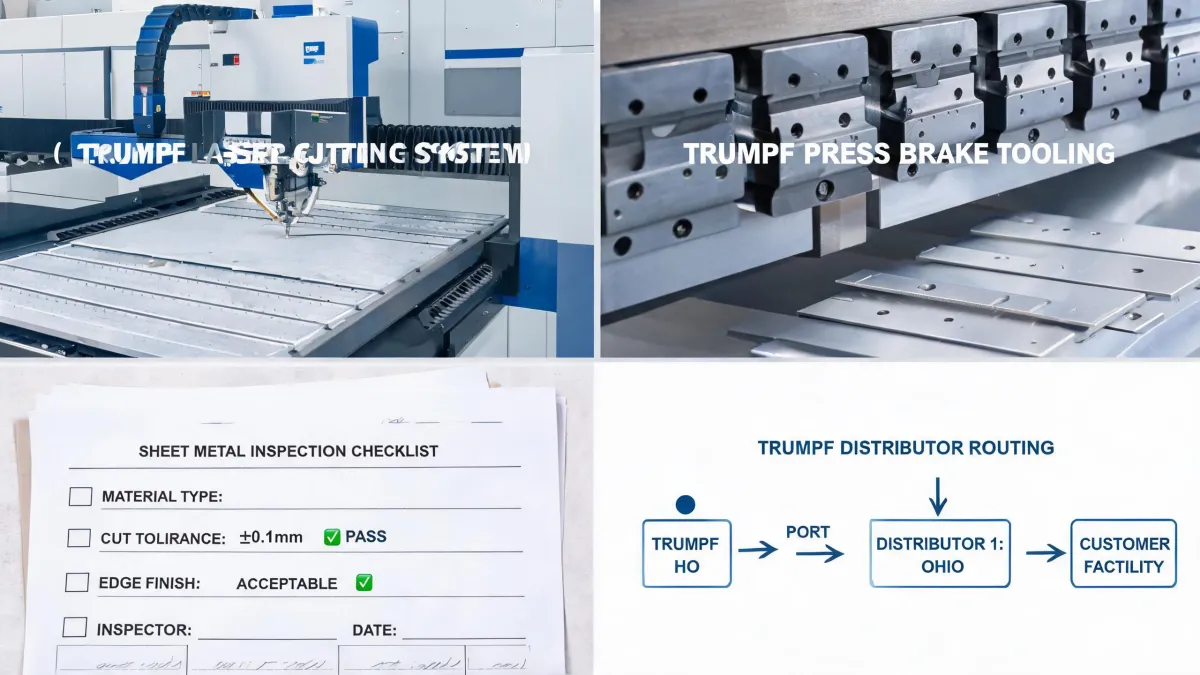
I've spent the last four years as the person who approves manufactured parts before they leave our shop. Every job gets measured, checked, and compared against the spec on the drawing. I review a little over 200 unique deliverables a year, and I keep a running list of the reasons parts get rejected. The list is not a secret document—it's how we train new staff and how we decide which equipment deserves space on our floor.
That last part is more connected than it sounds. When you're evaluating a used TRUMPF 3030 laser, a TRUMPF 3040, the Miller laser welder OptX, or a Raise3D E2CF industrial 3D printer, you're really deciding what kind of quality problems you want to have. No single machine solves all of them. So here's a breakdown by the three scenarios I run into most often in fab shops: (1) you're cutting sheet metal and wondering if a CO2 laser still makes sense, (2) you're joining thin metal and eyeing a laser welder, and (3) you're tired of waiting on fixtures and considering an industrial 3D printer.
Scenario A: Sheet Metal Cutting — Should You Still Buy a CO2 Laser?
Let's deal with the phrase that follows every mention of "CO2 laser" these days: fiber everything. The conventional wisdom is that CO2 is dead and anyone buying one is throwing money away. To understand why that's not the whole story, you have to look at what each technology actually does on thicker materials.
A modern fiber laser is a strong choice for thin sheet—1mm to 6mm steel and aluminum. It's fast, efficient, and costs less to run than CO2. On a 2mm mild steel part, fiber wins on speed almost every time. If that's your work, skip the CO2 discussion and look at fiber systems.
But the 6mm to 15mm range is a different conversation. In my inspection experience, a well-maintained CO2 machine still produces a visually cleaner and more consistent edge on 12mm plate than a fiber unit in the same power class. Less dross, better edge squareness, and a smaller heat-affected zone on some alloys. For jobs that go straight into welding without a machining pass, that edge quality translates into real cost savings.
According to TRUMPF's published specification sheets, the TruLaser 3030 handles sheets up to 3000×1500mm, while the 3040 processes up to 4000×2000mm. Both have been workhorses in job shops for decades. And because the market shifted toward fiber, used 3030 and 3040 CO2 machines have dropped to prices that can be extremely attractive.
I've audited one shop where a used 3030 runs fifteen hours a day and still passes every part inspection. I've audited another where the same model sits idle because nobody understood the purge sequence. The machine didn't change—the support system did.
So, is a CO2 laser worth the money? It can be—under a specific set of conditions:
- Your material is mostly 6mm or thicker steel.
- You find a machine with verifiable service records, not just a friendly seller.
- Your electricity costs are reasonable, because CO2 uses noticeably more power.
- You have someone comfortable with daily maintenance—mirror checks, gas refills, purge cycles.
What most people don't realize is that the hour meter on a used laser tells you far less than the maintenance log. I've reviewed a 4,000-hour machine with a corroded cooling loop that made it unusable in summer, and a 20,000-hour machine that cut within spec because the previous owner followed the maintenance schedule. If the seller cannot show you gas consumption logs and resonator service records, treat the machine as a rebuild project, not a plug-and-play bargain.
Scenario B: Thin Metal Joining — the Miller Laser Welder OptX
If you've ever welded thin stainless, you already know the problem. A hand-held TIG torch puts a lot of heat into a small sheet, and the metal warps before you can finish the pass. The Miller laser welder OptX is built for that exact pain point. It delivers a focused beam with low total heat input, so you get a clean, narrow weld with minimal distortion. The result is a huge reduction in grinding and polishing time.
From a quality standpoint, the biggest benefit I've seen is consistency. Manual TIG welds vary with operator fatigue, coffee intake, and all the other human factors. Laser welds, even hand-held ones, are far more repeatable. In our own shop, the rework rate on a thin-gauge stainless line dropped significantly after we brought in a laser welding process.
That said, the OptX is not a TIG replacement for everything. It's designed for thinner materials and cosmetic or lighter structural work. If you're welding 10mm structural steel, you still need MIG or TIG. And it doesn't eliminate the need for good process fundamentals: joint prep, shielding gas coverage, and technique all still matter. I've seen a supplier blame the machine for failed test coupons when the root cause was gas flow settings.
Dodged a bullet on this one. We insisted on welding test coupons with our actual material before committing. The supplier's demo was perfect on clean stainless offcuts. But on our brushed 2mm sheets with surface variation, nearly every parameter had to change. If we'd bought without that test, we'd have had a very expensive learning curve.
One more thing: laser welding brings a safety layer that traditional arc welding does not. You're dealing with a high-power laser beam in a hand-held tool. ANSI Z136.1 is the baseline for safe laser use, and your shop needs proper eyewear, screening, and a written procedure before anyone pulls the trigger. This is not an optional add-on.
Scenario C: Prototypes and Fixtures — the Raise3D E2CF Industrial 3D Printer
Now for the Raise3D E2CF industrial 3D printer. It's often marketed as a desktop production machine, and that's where expectations start drifting from reality. The E2CF is a dual-extruder system with an enclosed build chamber and a 330×240×240mm build volume, according to Raise3D's published spec sheet. The "CF" means it's set up to handle carbon-fiber-reinforced filaments like nylon and PETG with chopped carbon fiber.
In a fab shop, the right job for this machine is straightforward: jigs, drill guides, assembly fixtures, end-of-arm tooling, and fit-check prototypes. Instead of sending a fixture design out for machining at $150 plus a two-day wait, you can print it in five hours for ten dollars in material. In shops with steady fixture demand, I've seen the E2CF pay for itself in less than two months.
The trap is treating printed parts like machined metal parts. Carbon-fiber nylon is stiff, but it's much weaker between printed layers than it is along them. A drill guide is fine. A load-bearing bracket that supports thirty kilos in production is not. I've watched that mistake cost a shop an entire production run and put someone one step away from a serious injury.
Here's something vendors won't tell you: carbon fiber filament is abrasive. A standard brass nozzle will wear out quickly, causing under-extrusion and poor layer bonding, and most operators blame the printer or the filament. Switch to hardened steel or ruby nozzles on day one, before you run any carbon-fiber material.
When the E2CF makes sense
- You already fabricate parts and would otherwise machine or outsource most fixtures.
- Your tolerance requirement for the printed part is around ±0.2mm or looser.
- You have someone who can model a simple bracket in CAD without hand-holding.
And the unpopular opinion: if you don't have a steady stream of fixture requests, don't buy it. A 3D printer sitting idle is overhead, not capability. It needs dry filament storage, regular calibration, and an operator who understands extrusion settings. That's only worth it if the machine is running often.
How to Tell Which Scenario You're In
Here's the part that actually settles the debate. Walk through these four questions the same way I do when I audit a supplier's process:
- What thickness are you cutting most? Under 6mm—fiber laser territory. 6mm to 15mm—a used CO2 machine like the TRUMPF 3030 or 3040 is legitimately worth evaluating.
- What's the number one cause of rework? Ugly edges on thick plate—laser cutting equipment deserves priority. Welding distortion and grinding time—look at the Miller OptX. Missing fixtures when you need them—the E2CF starts solving real problems.
- What tolerance does the customer actually require? If it's ±0.1mm or better, you need a rigid cutting or machining process. If it's ±0.2mm or looser, a calibrated 3D printer is defensible for a lot of tooling jobs.
- Who will own the process? The best equipment fails without a competent operator. If you don't have a laser-safety culture or someone who understands process parameters, budget for training before hardware.
I still kick myself for not running a material test on a used TRUMPF 3040 before we signed the purchase order years ago. The sales demo cut perfectly—on their material, with their parameters. Our 8mm plate with our required edge standard told a different story. Twenty minutes of testing would have saved us two months of dross and rework.
The best equipment decision is not about which machine is newest or most popular. It's about which machine handles the work you already have without adding new quality problems.
Bottom line: a CO2 laser is not automatically a bad investment in 2025. It's a niche investment with a real place in shops that cut thicker steel and need edge quality. The Miller OptX is a game-changer for thin-gauge joining if you train people and set realistic expectations. The Raise3D E2CF is a smart buy when you have a steady flow of fixtures. The right move isn't whichever machine has the best spec sheet—it's whichever one fits the work you already have.