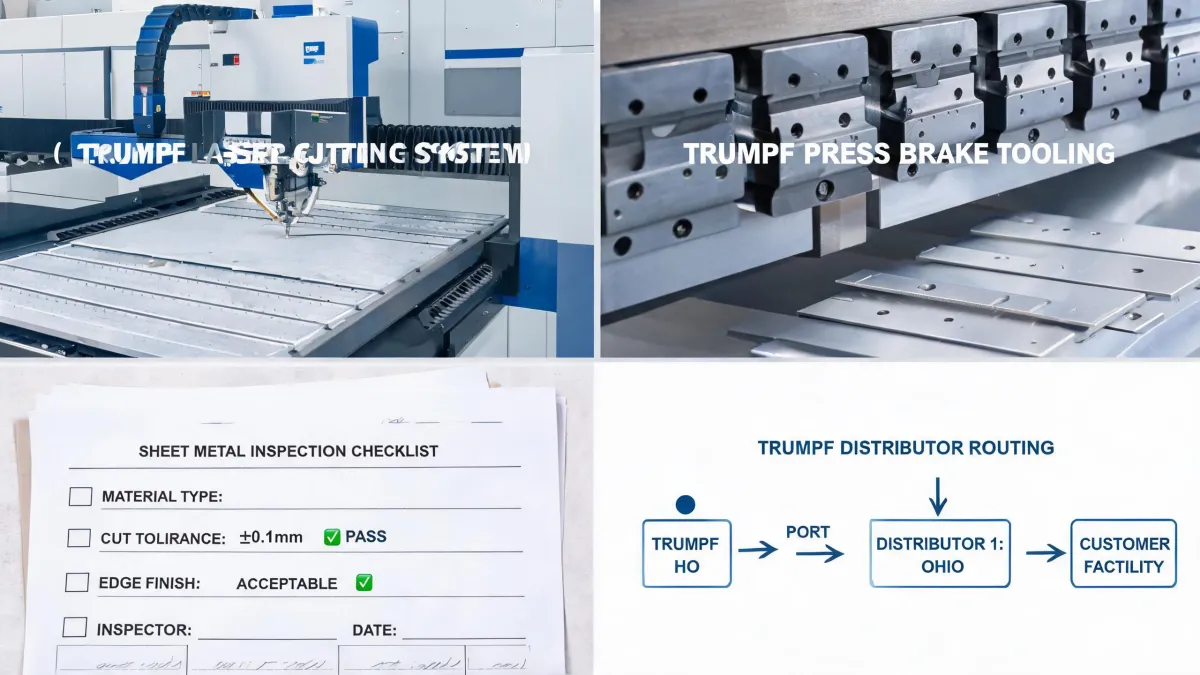
Let's talk honestly. I manage purchasing for a 120-person sheet metal and machining company. Every year I approve roughly $300K in equipment and service contracts, and I report to both operations and finance. That means I can't get away with recommending a machine because the demo looked nice. The numbers have to make sense.
If you are researching TRUMPF, you probably searched for one of five things: the TRUMPF fiber laser cutting speed chart for mild steel, TRUMPF laser welding, best 3D printers for dental professionals, best multicolor 3D printer 2025, or how a CNC press brake works. These are separate decisions, and they need different questions. Here is how I work through them.
Scenario 1: TRUMPF Fiber Laser Cutting Speed Chart (Mild Steel)
Start with the thickness range. A TRUMPF fiber laser is at its best on mild steel below 10 mm. If your work is mostly thicker plate, a different machine may be a better fit. But for typical job-shop sheet metal, fiber is now the default. I keep a copy of the speed chart near my desk, but I don't trust random online versions unless they include machine power, assist gas, and nozzle assumptions. If I remember correctly, a 6 kW TruLaser with a standard cutting head runs around these numbers for mild steel:
| Mild steel thickness | Cutting speed (6 kW fiber laser) | Typical assist gas |
|---|---|---|
| 1 mm | 18–22 m/min | Nitrogen |
| 2 mm | 12–15 m/min | Nitrogen |
| 3 mm | 8–10 m/min | Nitrogen |
| 4 mm | 5–6 m/min | Nitrogen or oxygen |
| 6 mm | 3–4 m/min | Oxygen |
| 8 mm | 2–2.5 m/min | Oxygen |
| 10 mm | 1.5–2 m/min | Oxygen |
Those numbers are a rule of thumb, not an official TRUMPF process chart. TRUMPF's support portal publishes machine-specific parameter tables, and your controller has the actual settings. Depending on laser power, focal position, nozzle condition, and gas pressure, you can cut faster or slower. Actually, that's a bit misleading: for a single machine, the fastest speed is rarely the most profitable. The best speed is the one that gives you clean edges and consistent part quality.
At 1–3 mm, nitrogen gives a clean, bright edge with no oxide. At 6–10 mm, oxygen usually produces better edge quality but leaves a thin oxide layer that matters if you are powder coating afterward. The chart above assumes clean gases and a fresh nozzle.
If you are a small shop, don't assume you need a brand-new 12 kW laser. We ran a used TruLaser for two years before upgrading, and it paid for itself on 3 mm and 6 mm parts. The first machine doesn't need to be the biggest; it needs to match the work you already quote.
Honestly, I'm not sure why some shops still use CO2 lasers for mild steel under 10 mm. My best guess is they have a large installed base, or they also cut heavy plate. But for most shops, fiber is faster, cheaper to run, and simpler to maintain. That doesn't mean CO2 is bad—it just isn't the obvious choice in that thickness range.
Scenario 2: TRUMPF Laser Welding: When Does It Actually Save You?
TRUMPF laser welding is not a replacement for every weld station. It shines when parts are thin, joint fit-up is tight, and weld appearance or heat distortion matters. A TruDisk or TruFiber laser is delivered through a robot arm or handheld head. It forms a narrow keyhole weld that is deep and fast—but it also tolerates only small gaps. If your parts have gaps, no laser will save you.
Handheld laser welding has become popular because it is easier to learn than TIG. But it still requires clean material and good fit-up. I went back and forth between a handheld laser welder and a TIG upgrade for our thin stainless parts for about two weeks. TIG was cheaper on paper. But our welders were spending more time cleaning discoloration than welding. We eventually leased a TruLaser Weld 5000 after TRUMPF's applications group ran our parts. It paid off in weld consistency, not in raw speed. In my opinion, consistency is the real reason to buy a laser.
One hidden cost is shielding gas. Laser welding needs high-purity argon or nitrogen flow, and that adds up. Also, if you are a small shop doing repair work on rusty or dirty materials, MIG is probably still the better tool. Don't let a social-media video convince you otherwise.
Before you buy, run your own parts. If a supplier won't handle a small trial order, that tells you everything you need to know. Small does not mean unimportant—it means potential.
Scenario 3: How Does a CNC Press Brake Work?
A CNC press brake is simpler than you think. It uses a top tool, called a punch, and a bottom die. The punch is pushed down by a ram, driven hydraulically or by electric servo motors. The sheet metal sits on the die, and a backgauge positions it to the right depth. When the punch enters the die, the metal bends. The real magic is control: the controller knows the punch position, and a sensor can measure the actual bend angle while the part is still being pressed. That measurement compensates for springback.
TRUMPF's TruBend series does this automatically. That matters because steel from the same coil can have slightly different springback depending on grain direction, thickness, and hardness. If you are bending a simple one-off part, you can compensate manually. If you are producing 100 brackets with tight tolerances, automatic angle measurement is worth a lot.
Buying advice: don't buy a 12-foot press brake just because it looks capable. A smaller electric machine often handles 80% of a fab shop's work, uses less energy, and occupies less floor space. For oversized parts, use a local bending service. I once watched a 10-foot press brake sit idle for six months at a friend's shop, mainly because the floor space was cheaper than the parts it would produce. Don't repeat that mistake.
Scenario 4: 3D Printing for Dental and Multicolor Are Different Machines
If the search best 3D printers for dental professionals brought you here, the TRUMPF TruPrint line is a serious option. These are laser powder bed fusion systems that melt metal powder, usually cobalt-chrome or titanium, into dense dental parts. Labs use them for crowns, bridges, partial denture frameworks, and implant-supported structures. The TruPrint 1000 is compact enough for a lab and is built around medical and dental workflows, from what I read on TRUMPF's product pages.
But the phrase best multicolor 3D printer 2025 points in a different direction. TRUMPF, as far as I know, does not make multicolor polymer printers. If your goal is full-color prototypes or parts with multiple materials in one build, you want a polymer jetting or multi-jet fusion system, not a metal powder bed machine. This mismatch happens more often than you would think.
For dental labs, the machine is only a piece of the total cost. You also need powder sieving, argon, post-processing, and often ISO paperwork. I might be misremembering details, but the per-part cost of metal powder is not trivial. Budget for the ecosystem, not just the printer.
How to Know Which Scenario You Are In
Work backward from the question you asked:
- If you searched for a TRUMPF fiber laser cutting speed chart, ask whether your bottleneck is cutting flat sheet under 10 mm. If yes, get a test cut quote.
- If you searched for TRUMPF laser welding, ask whether your parts fit together tightly and whether weld appearance matters. If yes, request a sample weld.
- If you asked how a CNC press brake works, you probably need better forming repeatability. Write down your current setup time, then compare it with a TruBend angle-monitored workflow.
- If you searched for best 3D printers for dental professionals, metal TruPrint deserves a look. If you really need multicolor plastic, it doesn't.
At the end of the day, the best TRUMPF machine is the one that removes a specific bottleneck from your process. It doesn't matter whether you run a 5-person job shop or a 500-person plant. Test your parts, check the numbers, and buy for the work you do today—not the work you imagine doing someday.