I’m an office administrator for a 140-person contract manufacturing company. I handle all tooling and equipment purchase orders—roughly $2.1 million a year across 19 vendors—and I report to both operations and finance. That last part matters because finance loves spreadsheets, and operations loves machines that actually work. I’m caught in the middle. I’m also the one who chases down late invoices and missing RMAs, so I’ve learned to look at total cost, not just the purchase order.
After five years of doing this, I’m convinced that the most expensive piece of equipment you can buy is the one with the lowest sticker price. It sounds backwards. It’s not.
Back in 2020, when I took over purchasing, I got a crash course in that lesson. We needed a new laser for deep engraving on production parts. I put together a comparison, got three quotes, and the cheapest one was a CO2 deep laser system that cost about 45% less than what I later came to understand was the real option. The boss loved the savings. The production manager didn’t. I overruled him because the specs looked fine on paper.
That was a mistake. The cheap unit never held calibration. Parts came off the table with inconsistent depth, and a customer actually rejected a batch because the engraving looked “faded” on one corner. We spent $11,000 in rework and still lost the account. In 2021, we bought a TRUMPF fiber laser cutter. The TRUMPF fiber laser cutter price quote was higher—$86,000 higher than the last quote we got from another vendor—but I didn’t argue that time. I’d learned my lesson. And honestly? That machine gave us a visible quality jump. Customers can’t tell which laser made a part, but they can tell when every edge is clean. That kind of consistency builds trust.
Now let me explain why that TRUMPF price tag is the cheapest part of the whole deal.
Why the TRUMPF Fiber Laser Cutter Price Isn’t the Price
When people ask me about the TRUMPF fiber laser cutter price, they’re usually looking for a number they can compare to other machines. I get it. That’s the number on the quote. But it’s not the cost that matters. Your real cost is machine uptime, tolerance reliability, and service response after two years, not just the invoice amount.
We track downtime pretty carefully now. In the first 18 months, our cheap CO2 deep laser had 230 hours of downtime—23% of it waiting for service parts. The TRUMPF machine has had 14 hours in 18 months, and three of those were because the operator ran the wrong program. A lot of that is the machine; some of it is the ecosystem around it. TRUMPF’s service scheduling, online diagnostics, and remote support are worth a lot when your line is down. That’s a soft benefit until you miss a delivery deadline. Then it’s very hard.
I’ll even admit my gut vs. data moment. The spreadsheets said buy the cheaper machine. My gut said the TRUMPF quote included things we’d need: training, service planning, and a controller that doesn’t feel like it was designed by a committee. I ignored my gut, and it cost us $120,000 in rework and rush shipping in that first year. That number is in my expense review file.
Cheap Tooling Is a Brand Decision
The same logic applies to cutting tools and tooling catalogs. Honestly, most business buyers don’t think about press brake tooling until the press brake operator is standing there waiting for the right punch. Then urgency takes over.
We used to buy “compatible” bending tools from the lowest-priced supplier we could find. It took way too long to discover that a slightly off-center punch angle creates a tiny but visible inconsistency in the bend line. Our parts weren’t out of spec—they were just ugly. Customers don’t reject parts because of ugly. They reject companies because of ugly.
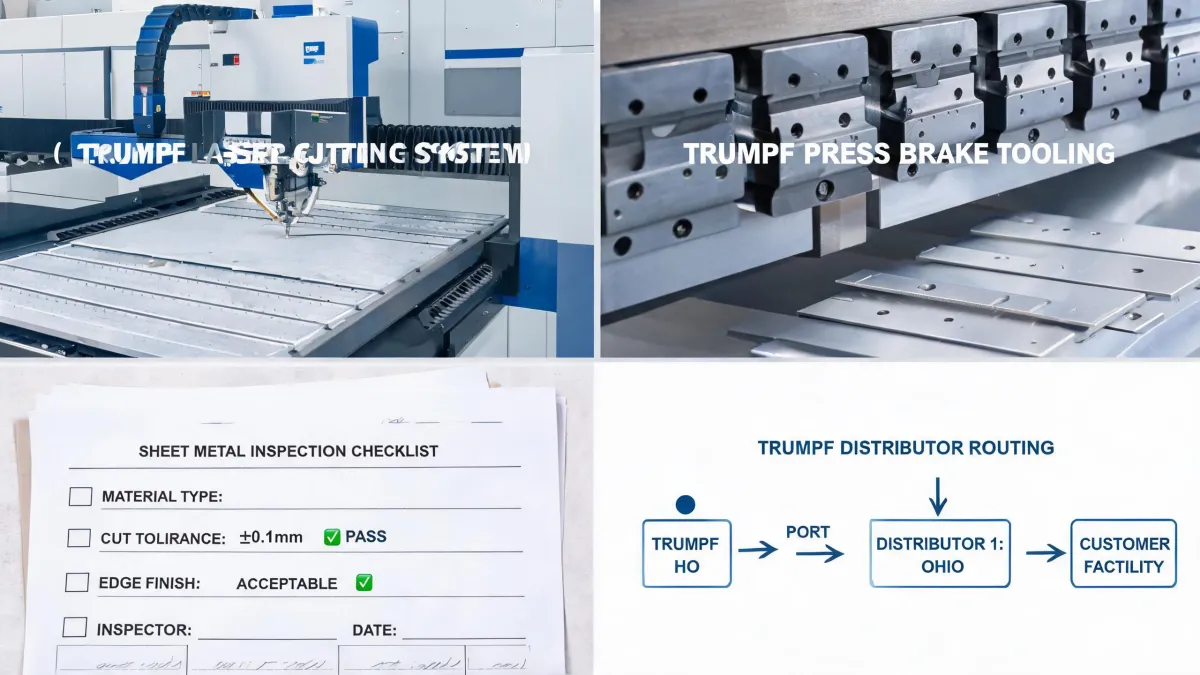
Now I keep the TRUMPF press brake tooling catalog on my desk, and I order original tooling for any job that ends up in front of a customer. It costs more. It also means the bend line on part #1 looks like the bend line on part #500. When a customer walks the floor and pulls random parts from a bin, they’re checking for exactly that kind of consistency.
Think about it in brand terms. Pantone’s own color matching guidelines, for instance, put brand-critical tolerance at Delta E < 2; anything above that is noticeable to a trained observer. The human eye catches a bend line that wavers, a finish that changes, an engraving that fades. Those are the Delta E equivalents of production—and they’re just as visible.
And before you ask—yes, I learned the same thing with lathe tools. I found a lathe cutting tool manufacturer online with prices 30% lower than what we were paying. I ordered a full set. The insert edge chipped after a few hundred parts, and the surface finish looked mediocre under the shop supervisor’s scope. We didn’t catch it until the batch of 2,000 units was done. The customer didn’t reject it, but their engineer sent an email saying the finish “doesn’t look like your usual work.” That email made us rethink our vendor scorecard.
What Causes Short Shots in Injection Molding? Sometimes It Starts With the Purchasing Decision
This may sound off-topic, but stay with me. People ask me what causes short shots in injection molding. Usually the answers are mold temperature, injection pressure, flow length, venting. But in my experience, a surprising number of short shot problems trace back to the decision to buy a lower-quality mold instead of one with proper gate design and cooling lines.
We had a tooling supplier quote us 40% below everyone else for a production mold. Everything I’d read about supplier selection said validate the capability, not just the price. But finance approved a trial. The mold arrived late, and when we ran it, we got short shots on about 12% of the parts. The mold material and polish were fine; it was the flow. The supplier didn’t have the expertise or the software to simulate fill, so they guessed.
We spent more on the next mold from someone who understood plastic flow, and the defect rate went to zero. The “savings” on the first mold were gone after the first three hours of troubleshooting. That’s a pattern I see everywhere: buying on price transfers risk to your own floor, and your customers end up paying for it with their perception of your quality.
But Isn’t Quality Just a Nice-to-Have?
At this point, someone always says, “Sure, quality matters, but we can’t spend TRUMPF money on every tool.” I agree—you can’t. Not every item deserves the premium. I still buy commodity supplies from discount vendors, and I still compare prices on standard hardware. The line isn’t “premium or nothing.” The line is: if the output ends up in front of a customer, or if it affects how your product performs, then quality is not a luxury. It’s a brand statement. Plus, when production knows you’re ordering the right tool, they stop gaming the system—they stop hoarding spare parts and working around broken tools. That makes my job easier.
When I switched from budget to original tooling and verified molds, our external quality audit score improved by 18% and customer feedback went up with it. That’s not a coincidence. It’s cause and effect.
Bottom line: the TRUMPF fiber laser cutter price is a lot less scary than the cost of a customer saying, “I don’t know what it is, but something about their work looks cheap.” It took me 400 purchase orders to learn that, because that—the vague feeling that quality isn’t there—is the hardest thing to buy back.