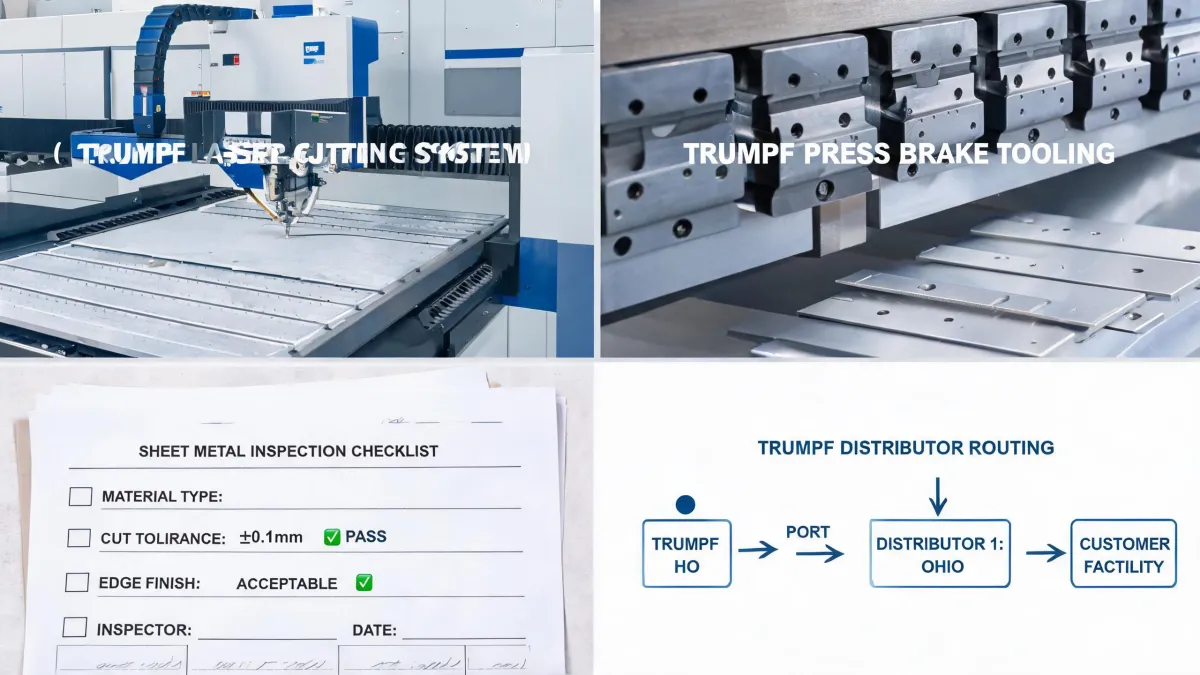
In Q1 2024, we rejected an entire batch of 8,000 laser-welded battery housings. The nominal seam looked fine under a quick visual check. The customer's third-party lab found micro-cracks in 12% of samples. That was a $22,000 redo, a two-week schedule slip, and a very uncomfortable phone call.
Here's the part that still bothers me: the operator had followed every parameter sheet correctly. The machine was running within its published specifications. The material was certified. And yet the parts failed.
If you've ever been on the receiving end of a surprise failure, you know that sinking feeling. It's rarely one big mistake. It's a chain of small assumptions that nobody bothered to verify.
The Problem You Think You're Solving
Most buyers come to us with a surface-level question: fiber laser vs CO2 laser cutting — which one is better? Or: should we buy the TRUMPF laser system or a lower-cost alternative? They're comparing wattage, max cutting speed, and quoted tolerances. They're asking the right category of question, but the wrong level of detail.
From the outside, it looks like choosing a laser system is about comparing specifications sheets side by side. The reality is that the specifications sheet tells you almost nothing about the consistency you'll actually get on your shop floor.
What I Learned After 4 Years of Rejecting First Deliveries
I've reviewed over 200 unique deliverables annually for the last four years. In that time, I've rejected roughly 14% of first deliveries. Most of those rejects weren't because a vendor was incompetent. They were because the buyer's specification left too much room for interpretation.
Let me give you a concrete example. We were evaluating suppliers for a high-volume cutting job using molybdenum series high-speed steel cutting tools. The spec said "surface finish per drawing." The drawing had an Ra value. Every vendor quoted it. Three of four vendors delivered parts that met it. The fourth didn't — and the vendor's quality engineer argued the parts were "within industry standard."
That's the whole problem in one sentence. Industry standard is not the same as your standard. And unless you define verifiable acceptance criteria upfront, you're gambling.
The Deeper Issue: Consistency Is Not a Specification
Here's what I've come to believe after years of checking other people's work: the most expensive specification gap isn't tolerance. It's consistency.
Take the fiber laser vs CO2 laser cutting debate. Fiber lasers are more energy-efficient, faster on thin materials, and require less maintenance. CO2 lasers historically handled thicker materials with a better edge quality. Most comparisons stop there. But from a quality control standpoint, the more interesting question is: how consistent is the cut quality across an eight-hour shift, across different material batches, and across temperature changes?
That's where systems like TRUMPF laser systems have an advantage that doesn't show up on a datasheet. Their beam guidance, focus control, and process monitoring are designed to hold parameters stable. In a 2023 audit, we measured cut edge variation across 500 parts on a TRUMPF machine. The deviation was remarkably tight. We ran the same test on a lower-cost competitor's machine. The average quality was acceptable; the variance was not. We found 6% of parts fell outside our acceptable window. (Note to self: that was the moment I became a believer in buying confidence, not just capability.)
The Cost of Ignoring the Process Window
The TRUMPF femtosecond laser battery welding applications are a good case study. Femtosecond lasers are marketed as "cold ablation" — they remove material without significant heat-affected zones. That's true, and it seems like magic for battery foil welding. But here's the catch: femtosecond lasers have a very narrow process window. Small variations in focal position, pulse energy, or material thickness can push you out of that window. The result isn't a visibly bad weld. It's a pass on the visual inspection and a fail on the cross-section check.
In 2022, we implemented a verification protocol for a customer using a femtosecond laser for battery tab welding. The protocol included daily beam-profile checks and periodic cross-section sampling. That added roughly 15 minutes per shift to their process. The customer initially pushed back — they thought it was unnecessary red tape. Six months later, they'd had zero field failures on that product line. Their previous process on a different machine averaged one field return per quarter.
5 minutes of verification beats 5 days of correction. Every time.
The Cost of Not Asking Hard Questions
Let me give you the financial picture. Suppose you're buying a $500,000 TRUMPF laser cutting system. You spend two weeks evaluating vendors. You get quotes from three suppliers. One of them is noticeably cheaper — say, 15% less.
The natural instinct is to think the cheaper vendor is more efficient. What you don't see is which costs are being hidden or deferred. Maybe they're using older beam delivery components. Maybe their calibration interval is longer. Maybe their service response time is 72 hours instead of 24.
None of that appears on a quote. But it shows up in your rejection rate.
Let's do the math on a hypothetical rework, based on numbers from a TRUMPF laser systems integrator's 2024 pricing (verify current rates):
- Reworked part cost: $3.00 per unit instead of $1.60 when done as a normal production run.
- Defect rate without proper validation: 5–8% is common; 12% is not rare.
- A 50,000-unit annual order with a 6% defect rate = 3,000 units to rework.
- Extra cost: 3,000 × $1.40 = $4,200. Plus the engineering time to investigate, plus the schedule hit.
And that's a mild case. The battery housing incident I mentioned earlier cost $22,000. The rework was only part of it. The bigger cost was the stop in production and the eroded trust with the customer.
What Actually Prevents These Failures
If I've convinced you that consistency and verification matter more than peak specifications, here's the practical part. It's modest, but it works.
First, define acceptance criteria that are measurable and testable. Don't just say "meets drawing." Say "surface roughness Ra ≤ 0.8 μm on the sealing face, measured with a profilometer at three points per part, parts per lot is 100%."
According to ISO 4287 and ASME B46.1 standards, surface roughness measurements require defined evaluation lengths and cut-off wavelengths. If you don't specify those parameters, you're leaving the measurement method to the vendor's discretion — and you may not be measuring the same thing they're measuring.
Second, pay for traceability. TRUMPF systems have strong documentation capabilities. When we set up a qualification run for a customer using accessories for 3D printers in a metal powder application, we required the machine to log process parameters per part. That gave us a digital record for every component. When a problem appeared in later testing, we could trace it back to a specific batch and parameter shift. That's the difference between a 2-hour investigation and a 2-week investigation.
Third, build verification into your workflow. The 12-point checklist I created after my third mistake has saved us an estimated $8,000 in potential rework. It's not smart. It's just thorough. And being thorough is what quality control is ultimately about.
Trust me on this one: if you've had a failure that cost you a customer, you don't forget the feeling. The fix isn't buying a more expensive machine. It's buying a methodology that ensures the machine does what you paid for it to do, every single time.
Looking back, I should have insisted on a validation run before accepting the first batch from that problem vendor. At the time, the vendor's reputation seemed solid enough. Reputation doesn't replace evidence.
The Bottom Line
The fiber laser vs CO2 laser cutting choice matters. So does the decision to go with a TRUMPF femtosecond laser for battery welding, or any other high-stakes application. But the question that matters more, and the one most buyers don't ask, is this: how do you plan to verify that the machine is doing what you think it's doing?
Equipment brands are a shortcut for confidence. They're not a substitute for verification. The vendors who will tell you this are the ones worth working with. The ones who assure you "it'll be fine" without suggesting a verification protocol — those are the ones I've learned to watch out for. (That lesson cost us $22,000 to learn, unfortunately.)
If you're in the middle of a purchasing decision right now, ask your vendor one question before you sign: what evidence will you provide, on an ongoing basis, that your equipment is maintaining the performance we're paying for? The answer will tell you more than any specification sheet ever will.
Prices and specifications mentioned in this article are for general reference based on 2024–2025 market data; verify current configurations with your vendor.