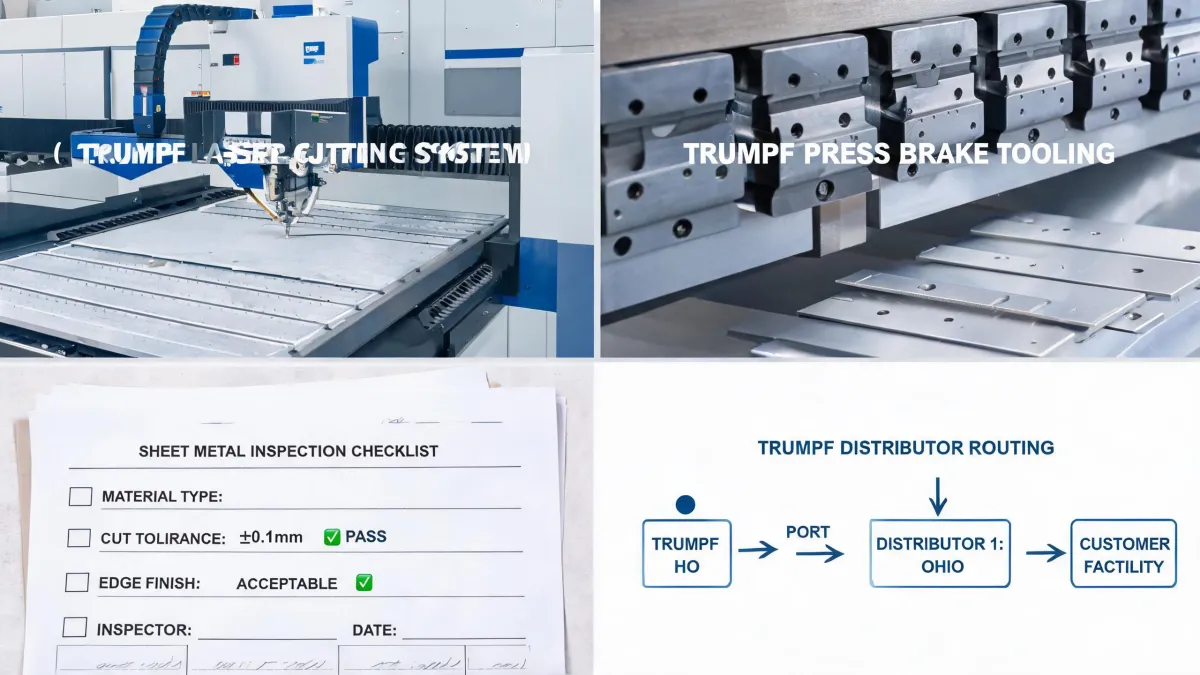
-
When This Checklist Applies
-
Step 1: Define the Part Geometry That Will Hit Your Machine 80% of the Time
-
Step 2: Compare the Setup Cost (Both Visible and Hidden)
-
Step 3: Evaluate the Software Ecosystem, Not Just the Hardware
-
Step 4: Test the Service Response Time (Not the Warranty)
-
Step 5: Look at the Resale Value (Even If You Plan to Keep It Forever)
-
Step 6: Don't Forget the Future—Is Your Product Mix Going to Change?
-
Common Mistakes and How to Avoid Them
I manage equipment purchasing for a 25-person precision sheet metal shop. In 2024, I evaluated three quotes for a new bending setup—TRUMPF press brake, a lower-priced alternative, and a laser combination machine. My initial assumption was simple: pick the one that fits the budget and hit order. Then I spent four months fixing the consequences of that assumption.
This checklist isn't meant to be an exhaustive guide to every spec. It's designed for people like me—administrative buyers who need a practical, repeatable process to evaluate equipment like a TRUMPF press brake or a trumpf 3030 laser system, without getting lost in marketing fluff.
When This Checklist Applies
Use this if you're buying your first power press brake or replacing an older model, and you're comparing a single vendor (like TRUMPF) across multiple machine types. It's also useful if you're evaluating a laser trumpf 3030 as a potential upgrade from a standalone press brake.
It doesn't apply well if you're comparing a brand-new TRUMPF press brake against a used machine from an unknown OEM. That's a different risk calculus.
Step 1: Define the Part Geometry That Will Hit Your Machine 80% of the Time
Before you look at any brochure, pull the last six months of production orders. Identify the most common bend lengths, material thicknesses, and complexity. This is your baseline. If you're considering a trumpf press brake (like the TruBend 5000 series), you need to know if 85% of your jobs fall within a 4-foot bed length and 3/16-inch mild steel, or if you need the full 10-foot capacity.
Why this matters: A machine that can handle your top 80% of parts efficiently will pay for itself faster than one that can handle 100% of your parts but does the common ones slowly.
Check point: Write down the maximum tonnage you actually used at least 10 times in the last year. Not what you might use someday.
Step 2: Compare the Setup Cost (Both Visible and Hidden)
Most comparison tables show the base machine price. Here's what I've learned to look for.
- Tooling cost: A TRUMPF press brake uses precision-ground tooling. Standard punches and dies are widely available, but specialized shapes (like hemming or radius tooling) can cost $1,000–$4,000 per set. If you need custom tooling, get a quote before you commit.
- Installation and rigging: I've seen quotes where the machine price is $120,000 and the rigging bill is another $8,000–$15,000. Confirm whether it includes leveling, anchoring, and electrical hookup.
- Operator training: TRUMPF offers standard training packages, but they usually cover the basics. If you have complex backgauge programming or want to use the bending simulation software, budget for an additional 2–3 days of advanced training.
Here's a mistake I made: I assumed the price per machine included tooling for the three most common part sizes. It didn't. I ate $2,400 on tooling I thought was included.
Step 3: Evaluate the Software Ecosystem, Not Just the Hardware
A TRUMPF press brake is tightly integrated with TRUMPF's bending simulation software (like BendPro or the VDA–ISA integration). If you're also using a laser trumpf 3030, the combined software stack can program both machines from the same model. This can cut programming time by 40% or more, but only if your team uses it.
Question: Are your operators comfortable with CNC programming and 3D simulation? If they prefer manual backgauge controls, you might not benefit from the software ecosystem. In that case, a simpler machine might be a better fit. I've seen shops buy a high-end press brake and then never use the software because the lead operator was set in his ways—a 40% cost premium for nothing.
Step 4: Test the Service Response Time (Not the Warranty)
Warranty terms are printed. Service response time is not. I call this the “Friday night at 4:55 PM” test.
Before I finalize any order, I always ask for the manufacturer's regional service schedule and the average time to get a technician on-site for a major breakdown. For critical equipment like a primary press brake, I want a response within 24 hours, not 72. TRUMPF's national service network in the US is generally good, but I've heard from shops in rural areas that response can stretch to 3–4 days. If you're in a rural zone, check whether you can get a loaner machine or remote diagnostics.
Step 5: Look at the Resale Value (Even If You Plan to Keep It Forever)
Nobody buys a press brake expecting to sell it in five years. But the resale market tells you something about reliability and long-term support. A 10-year-old TRUMPF press brake with regular maintenance still sells for 60–70% of its original price, if the tooling is included and the control system is updated. Lower-priced machines from off-shore OEMS often lose 80% of their value in the same period, not because they fail mechanically, but because parts sourcing and software support dry up.
I'm not saying buy solely for resale. I'm saying if you ever need to free up capital for an expansion, the resale value of a TRUMPF press brake gives you a clear exit. That's worth something.
Step 6: Don't Forget the Future—Is Your Product Mix Going to Change?
This is the step most people skip. I spoke with a job shop owner last year who bought a 6-foot press brake in 2022 because 95% of his parts fit. By 2024, his biggest customer was asking for parts that needed a 10-foot bed. He had to outsource the work, cutting his margin by 30%.
If you're investing in capital equipment, think 3–5 years ahead. If your product mix is stable, a dedicated trumpf press brake is great. But if you see a trend toward longer parts, or you're adding laser cutting and need to handle larger sheets, you might consider a combination machine like a punch-laser combo. It's not a sexy buy, but it gives you flexibility.
Common Mistakes and How to Avoid Them
- Mistake: Comparing horsepower and tonnage alone. The real performance difference is in the control system (backgauge accuracy, repeatability, and software integration). Two machines with the same tonnage can be 20% apart in actual throughput.
- Mistake: Ignoring the floor space requirement. A TRUMPF press brake with automated material handling needs 30–40% more floor space than the machine footprint suggests. Measure your loading area before you order.
- Mistake: Assuming all 'TRUMPF' models share the same feel. The laser trumpf 3030 is a flatbed laser cutter—it's used for cutting sheet metal, not bending. If you need both cutting and bending, you buy two machines. I've seen people try to use a laser cutter for light bending operations. It doesn't work.
Here's my honest advice: If 80% of your work is mild steel (3/16–1/2 inch) with relatively consistent part geometry, and you have an operator who can handle the software, a TRUMPF press brake is an excellent investment. But if you're doing short-run prototype work or exotic alloys (stainless content over 12%), you might want a machine with more flexible tooling options. I wouldn't recommend a TRUMPF press brake for a shop that gets a new customer order with a completely different geometry every day—it's too much setup time. The better option for that scenario is a machine with a quick-change tooling system, which TRUMPF offers in its higher-end models, but then the price goes up significantly.
I won't say TRUMPF is the right choice for everyone. But if your situation matches the checklist above, you can buy with confidence.