-
Scenario 1: High-Mix, Complex Parts, Short Lead Times → Fiber Laser
-
Scenario 2: High-Volume, Repetitive Features, Forming Needs → CNC Punch Press
-
Scenario 3: Cutting Is Fixed, Bending Is the Bottleneck → TRUMPF 5170 Press Brake
-
Scenario 4: Deadline Is Non-Negotiable → Pay for Certainty
-
A Cost Controller's View on TRUMPF Laser Focus Lenses
-
How to Tell Which Scenario You're In
If you're shopping for sheet metal equipment, someone will tell you the fiber laser is the obvious answer. Someone else will tell you the CNC punch press is the proven workhorse. I've been the procurement manager at a 40-person metal fabrication shop for seven years, and I've learned to ignore both types: there is no universal answer (at least, not one that survives contact with a real production schedule). It depends on your order mix, your capacity utilization, and your willingness to pay for a deadline. In practical terms, I see four situations: high-mix complex parts, high-volume repetitive parts, bending bottlenecks, and non-negotiable deadlines.
Let me start with a rule I've built into every purchase decision: compare total cost of ownership, not the sticker price. That means counting setup time, tooling, programming, floor space, maintenance, scrap, and the cost of a missed delivery. It's tempting to think you can just compare machine prices. But the costs that matter aren't on the quote sheet.
Scenario 1: High-Mix, Complex Parts, Short Lead Times → Fiber Laser
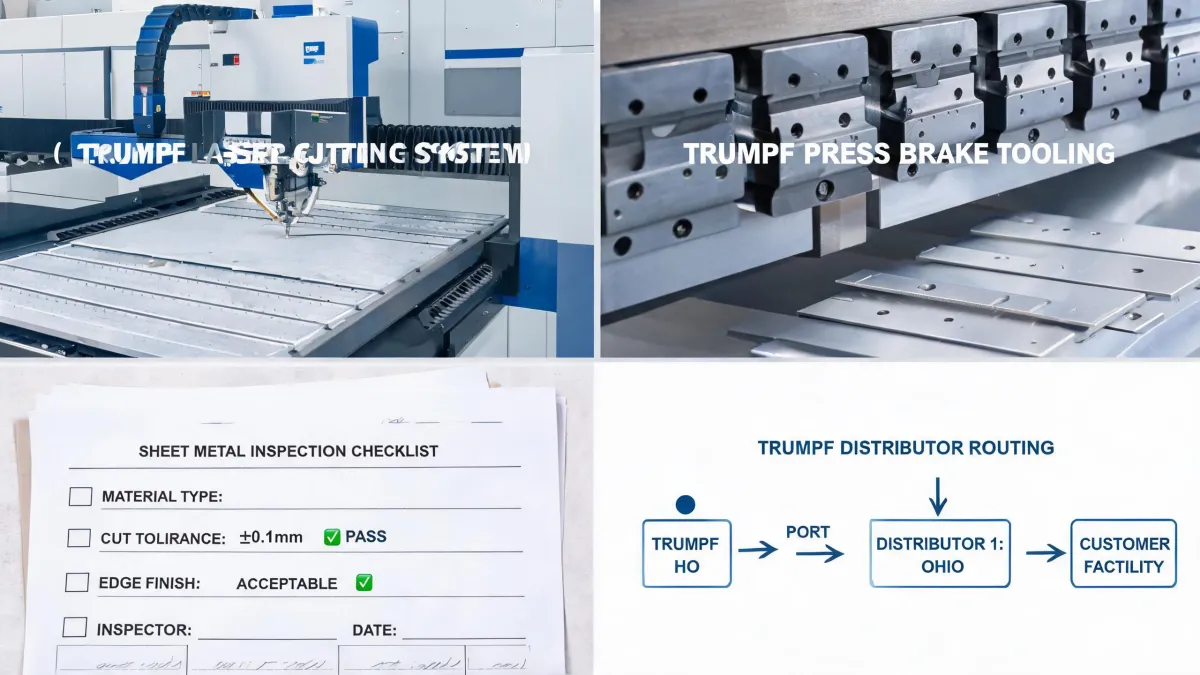
If your orders are custom brackets, prototypes, or aluminum parts with tight contours, a fiber laser is probably the better choice. Why? Because it has no tooling. A CNC punch press requires a different punch and die set for every hole shape. A fiber laser can cut any shape from a CAD file, which means changeover time is near zero.
This is where TRUMPF's TruLaser series earns its reputation. It's not just the raw kilowatts—it's the cutting parameters, the software, and the support. For a job shop with a mix of 10-piece runs and 200-piece runs, a fiber laser can beat a punch press on cost per part once you include tooling and programming.
If you're a CNC machining aluminum parts wholesaler, laser cutting is one step in the chain. If your parts have complex internal cutouts, the laser's edge quality can reduce downstream machining time. That's a real cost win. But it only matters if the laser itself is busy enough to justify the monthly payment.
Three years ago, every cost model I built said buy a fiber laser. My gut kept going back to our part mix—lots of short-run aluminum parts, not enough volume to feed a machine 40 hours a week. We partnered with a local laser shop instead. Two years later, our per-part cost was lower than the buy model predicted. That's not because lasers are bad; it's because our utilization was too low.
Scenario 2: High-Volume, Repetitive Features, Forming Needs → CNC Punch Press
Fiber laser vs CNC punch press advantages aren't universal. A punch press is still difficult to beat for high-volume, repetitive work. It's faster than a laser when you're making the same 20 holes in 1,000 identical panels. It can also emboss, louver, tap, and form—things a laser can't do.
If your product line is stable, you run large batches, and you need formed features, a CNC punch press should probably be in your plan. TRUMPF's TruPunch and punch-laser combos give you both cutting and forming in one cell, but that's a high-investment decision. The combo makes financial sense when utilization is high and setup cost is your bottleneck.
The key is not to compare laser vs punch press as if they're rivals. They're tools for different production profiles. The right question is: what does my part mix look like over the next five years?
Scenario 3: Cutting Is Fixed, Bending Is the Bottleneck → TRUMPF 5170 Press Brake
Laser cutting doesn't fix bad bends. If your shop already has a laser, the next bottleneck is often bending. The TRUMPF 5170 press brake is a legitimate workhorse for medium-to-heavy sheet metal, with the rigidity to hold tolerances across long flanges. But a press brake is another large machine—and it only earns its keep if the bending volume is there.
We watched our outside bending costs for 18 months before we bought our TruBend 5170. The breakeven point was roughly 42 hours per week of bending. When we hit 55 hours, the machine became the obvious financial winner. I won't pretend that number applies to your shop—that's not how TCO works. But the habit of tracking outside costs before buying is.
I'll also confess: even after we signed the order, I kept second-guessing. What if the bending volume dropped? The first six months were stressful. It wasn't until we hit our utilization target that I relaxed. That uncertainty is real. It's why I'd rather run the numbers for three months than trust my gut on a machine purchase.
Scenario 4: Deadline Is Non-Negotiable → Pay for Certainty
Here's where I have a bias that some procurement people will question: when a deadline is absolute, I will pay a premium for delivery certainty.
I used to reject every rush fee on principle. Then in March 2024, we had a customer who needed an aluminum prototype in 48 hours. Our laser was booked, and the local quote was $400 higher than the out-of-state shop. The out-of-state shop said 'probably by Thursday.' The local laser cutting Dunkirk NY job shop said 'guaranteed by Wednesday; if not, it's free.' I paid the $400 extra.
The guarantee was in writing, with a specific delivery time and a penalty if they missed it. That's the kind of claim the FTC would expect a business to substantiate—and for me, it's the difference between a quote and a gamble.
The alternative was missing a $15,000 order and damaging a relationship we'd built over four years. In my opinion, the rush fee wasn't an expense—it was the cheapest insurance I bought that month.
This is why I keep a local shop on speed dial. A laser cutting Dunkirk NY shop with a fiber laser can usually handle same-day work, and that local availability is a financial hedge. 'Probably on time' from a distant vendor creates a hidden risk. In an emergency, the known cost of a rush fee is almost always less than the unknown cost of a missed deadline. Take this with a grain of salt: I've been burned twice by vague delivery promises, so maybe I'm over-indexing on certainty. But neither of those burns was cheaper than the rush fee would have been.
A Cost Controller's View on TRUMPF Laser Focus Lenses
If you already run a TRUMPF laser, you'll eventually need replacement focus lenses. It's tempting to buy the generic lens and save $100. But I've learned to split the difference.
We tested compatible TRUMPF laser focus lenses from three suppliers. One worked fine. One worked until the coating degraded under high power. One didn't focus to spec out of the box. That's not an attack on aftermarket parts—it's a call for verification. A lens that fails halfway through a run costs far more than the lens itself: scrap, labor, wasted machine time, and possibly a late delivery.
So my rule is simple: for critical jobs, use the TRUMPF lens. For prototyping or low-stakes work, test aftermarket lenses and track the results. If a lens survives 200 hours under real conditions, then you can rationally price the risk. Until then, the savings on a $120 lens doesn't justify a $1,200 rework event.
How to Tell Which Scenario You're In
Still on the fence? Stop looking at machine brochures and start looking at your own data. Spend two weeks logging every part that comes through your shop:
- Material type and thickness
- Order quantity (1-10 parts or 100-1,000?)
- Number of holes, forms, and contours
- Deadline urgency
- Secondary operations required
Then ask three questions. Is your order mix changing daily, or is it stable? Does your workflow need forming features? If a machine went down today, would a local supplier be there to cover you?
If your average order is small and complex, lean toward the fiber laser. If orders are large and repetitive, the punch press is likely the lower-TCO answer. If bending is your bottleneck, price the TRUMPF 5170 press brake against outside bending costs. And if time is critical, pay for certainty.
The bottom line: there is no universal answer. The wrong answer is buying the machine that impresses your neighbor instead of the one that fits your cost per part. I'd rather be the procurement manager who paid too much for a rush laser cut than the one who bought a $600,000 machine that runs two shifts a week.