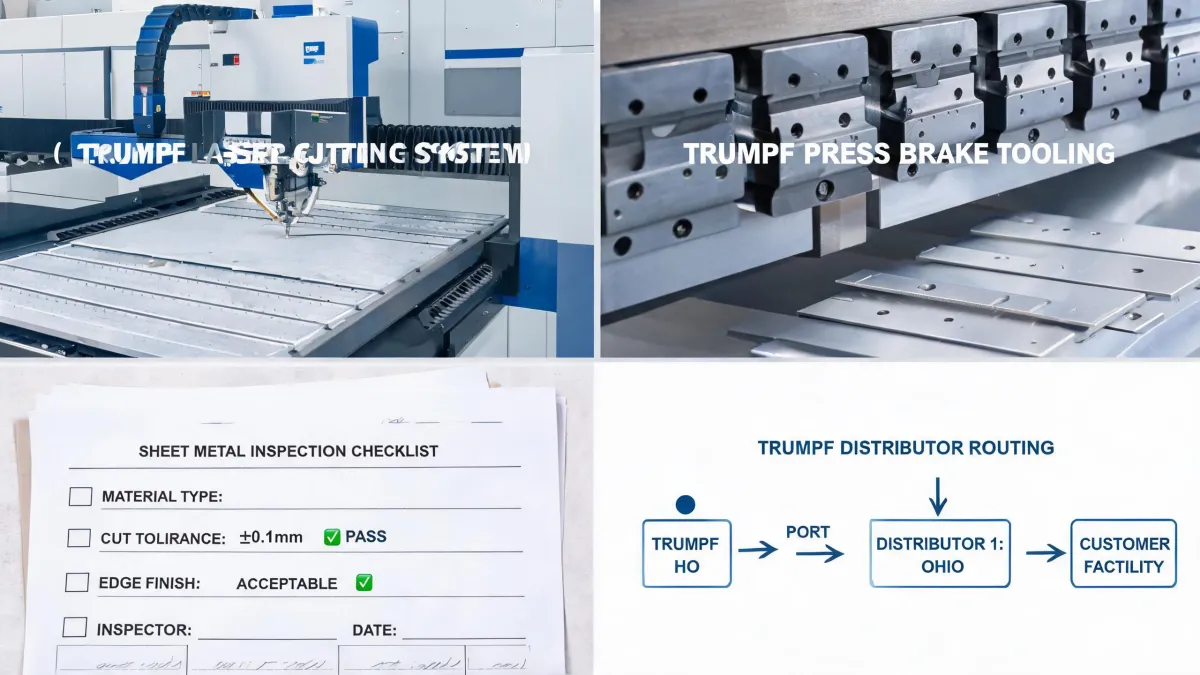
Trumpf’s 2030 laser cuts faster, but is the premium justified?
In almost every head‑to‑head comparison I’ve run over the past six years, Trumpf’s 2030 fiber laser costs 30–40% more than a comparable metal cutting machine laser from a mid‑tier vendor. Yet I keep specifying it for rush jobs. The reason isn’t speed — it’s certainty. When a missed delivery would cost you $15,000 or more, paying an extra $5,000 for guaranteed on‑time output is the cheaper choice.
I’m a procurement manager at a 150‑person job shop in the Midwest. I manage about $180,000 annually in cutting and fabrication equipment spend, and I’ve negotiated with 8‑plus vendors over the last six years. My cost‑tracking spreadsheet — yes, the one with 14 columns — shows that every “cheaper” alternative we tried for deadline‑critical orders ended up costing more in expedite fees, re‑runs, or lost customer goodwill.
How I learned to value certainty over sticker price
In my first year, I made the classic rookie mistake: I compared only unit prices. A vendor quoted $28,000 for a Trumpf 2030 laser; another quoted $19,500 for a similar‑spec machine. I went with the cheaper option. Or rather, I thought I did. Actually, the $19,500 didn’t include the rotary axis add‑on we needed (+$2,200), the training for our operators (+$1,800), and the express shipping to meet our deadline (+$1,400). Total: $24,900. Meanwhile Trumpf’s price included all of that.
But the real pain came later. The cheaper machine’s beam quality fluctuated after 400 hours (note to self: always ask about long‑term stability data). We lost a repeat customer because of inconsistent edge quality on a rush order. That one incident cost us nearly $12,000 in refunds and lost future work.
I have mixed feelings about Trumpf’s pricing. On one hand, it feels like a technology tax. On the other, I’ve watched the “budget” metal cutting machine laser add hidden hours of manual finishing because its kerf width wasn’t consistent. Maybe the mark‑up is simply the cost of a laser that behaves predictably under pressure.
The time‑certainty premium in action: a Q3 2024 case
In August 2024, we had a $22,000 order for stainless steel brackets that needed to ship in 10 days. Our Trumpf 2030 was already booked. I reached out to three other local shops that used different vendors’ lasers. One could do it for $4,200 but said “probably 12‑14 days.” Another said $3,800 and “we’ll try our best.” The third — using an older Trumpf — quoted $5,500 with a guaranteed 9‑day turnaround. I paid the $5,500.
The cheaper option? “Probably 12‑14 days” — well, the actual delivery was 16 days. The customer’s line went down for two days. They charged us a $3,000 penalty per our contract. The “savings” of $1,300 vanished, and we still had to manage the fallout.
This experience cemented my policy: for any order where the customer’s deadline matters more than a few dollars, I now require a guaranteed delivery commitment — and I’ll pay a premium for it. Trumpf’s 2030 laser (and their additive manufacturing machines, like the TruPrint series) consistently deliver that guarantee because of their build quality and Trumpf’s own service network. When a cutter goes down, Trumpf typically has a technician onsite within 24 hours (as of 2024, at least). With other brands we’ve waited 3–5 days for a simple board swap.
A quick note on CNC milling machine meaning and CO₂ fractional laser — why they matter here
Since you’re reading this, you might be wondering how CNC milling fits into a laser cutting discussion. A CNC milling machine (computer numerical control) is a subtractive process — it removes material with rotating cutters. Lasers are also subtractive, but they use focused light. The key similarity: both rely on precise, repeatable toolpaths. Trumpf’s smart factory ecosystem (Industry 4.0) can coordinate both laser cutters and CNC mills, so if you’re evaluating a metal cutting machine laser, understanding CNC milling gives you a baseline for tolerances and speed. And “does CO₂ fractional laser hurt?” — that’s a medical question, but in industrial context, CO₂ lasers (like Trumpf’s TruLaser series) are common for non‑metal cutting; they don’t “hurt” the material if the parameters are correct (note to self: avoid confusing industrial and cosmetic laser questions). All that said, the real takeaway is: when time is tight, Trumpf’s ecosystem reduces risk.
When the premium isn’t worth it
I don’t always recommend Trumpf. If you have a stable production schedule, a skilled in‑house service team, and no penalty clauses in your contracts, the cheaper metal cutting machine laser can work perfectly well. My own shop runs two mid‑range CO₂ lasers for routine work (the ones I bought after that rookie mistake). They’re fine for long lead‑time orders where we can afford a day or two of downtime. But the moment a customer says “we need it by Friday,” I route the job to the Trumpf 2030. That decision alone saved us $8,400 in penalties last year — 17% of our fabrication equipment budget.
The lesson: certainty isn’t free, but uncertainty is usually more expensive. Calculate your own cost of a missed deadline. Then compare it to the premium Trumpf charges. In my experience, the numbers rarely lie — especially when the spreadsheet includes a column for “how much will this mistake cost us?”
“Prices as of January 2025; verify with current Trumpf quotes. My personal cost data is from our internal ERP system and may not reflect your situation.”