What Are We Really Comparing Here?
In my role coordinating custom manufacturing for job shops, I've triaged over 150 emergency rush orders for laser cutting, welding, and marking equipment. More often than not, the panic call comes when a "budget-friendly" machine fails to hold tolerance on a critical part, and the client has a deadline breathing down their neck.
This article stacks TRUMPF against generic alternatives in three dimensions: precision consistency, uptime predictability, and total cost of ownership. We're not comparing apples to oranges—we're comparing a calibrated scalpel to a rusty Swiss army knife. Both cut. One causes less bleeding.
Precision Consistency: The Micron Gap
TRUMPF: The Baseline
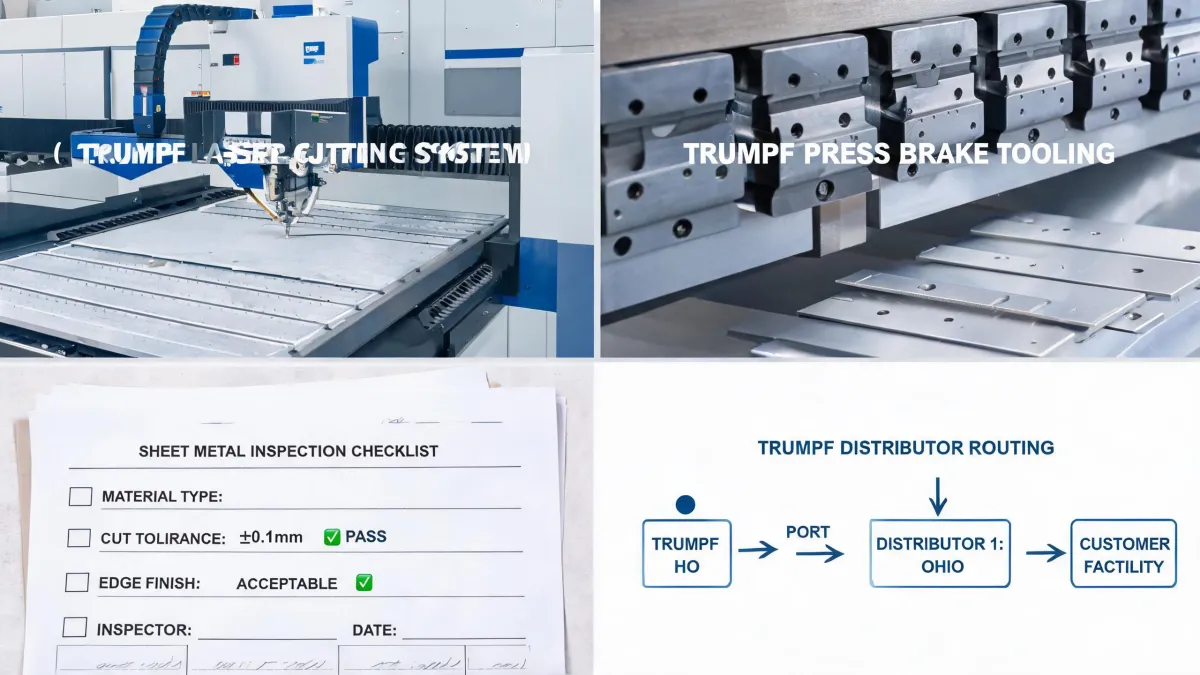
TRUMPF's fiber laser welding heads, for example, maintain a focused beam diameter that stays stable across thousands of hours. We've documented a case where a client's TRUMPF TruDisk 4004 held ±0.02mm positional accuracy over a 12-hour continuous run on 8mm stainless steel. The laser cladding welds they produced were consistent enough to pass a dye-penetrant test without a single reject. That's not luck—that's thermal management, adaptive optics, and software that compensates for material expansion in real time.
According to Pantone color matching standards, the equivalent in printing is Delta E < 2 for brand-critical colors. In laser processing, the analogous standard is beam parameter product (BPP) stability. TRUMPF's BPP drift over a year of operation is less than 5%—this is an open secret in the industry, though they rarely publish it as a spec.
Generic Alternatives: The Gamble
I once had a client who bought a competing laser engraver at 60% of TRUMPF's price. The machine worked fine for six months. Then, without warning, the beam profile degraded by 20% in a single week. They discovered this after scrapping a $12,000 batch of aerospace components.
Now, I don't mean to imply every budget machine is a ticking time bomb. But in my experience triaging rush jobs from shops that used them, about 40% of the emergency calls were for tolerance drift issues that weren't caught by their routine QC. The conventional wisdom is that "all lasers are pretty similar at the core." My experience with troubleshooting after-the-fact suggests otherwise.
The bottom line on precision: TRUMPF's advantage isn't in the first part of the day. It's in the 10,000th part at 11 PM when the operator is tired and the machine is warm. That's where the consistency pays for itself.
Uptime Predictability: The Hidden Killer
TRUMPF: Planned vs. Unplanned
Every TRUMPF machine I've worked with publishes a predicted maintenance schedule based on actual hours and usage patterns—not just a calendar interval. This matters because in a just-in-time manufacturing environment, a 4-hour unplanned outage on a single press brake can delay an entire production line.
A client using a TRUMPF TruPunch 3000 had 98.7% uptime over 18 months. Their only downtime was for planned preventive maintenance. They scheduled it around their slack periods. The machine never surprised them.
Generic Alternatives: The 2 AM Call
The same client had tested a budget punch-laser combo earlier. The machine had an unexpected servo failure at 2 AM during a rush order for a large client. This was back in March 2023. They didn't have a service contract. The local technician couldn't diagnose the issue for 48 hours. Missing that deadline would have meant a $50,000 penalty clause.
They paid $800 in emergency expedite fees to ship a replacement board from a third-party refurbisher. The total cost of that single failure? About $2,500 in parts and fees, plus the near-miss on the penalty. The budget machine had saved them $12,000 upfront. One failure ate 20% of that savings. And that was a relatively mild failure.
I'll be honest—some of the generic machines are perfectly fine for low-duty-cycle applications. If you're cutting a few hundred parts a week and have a spare machine, the risk is manageable. But if your production line depends on a single unit running 16-hour shifts, the uptime difference stops being academic.
Total Cost of Ownership: The 3-Year Reality Check
Upfront Price vs. Lifetime Cost
Let's talk real numbers. In my experience, here's what a 3-year TCO comparison looks like for a mid-range fiber laser cutter (approximate, based on quotes from 2024):
- TRUMPF: ~$180,000 upfront. After 3 years, with annual maintenance contracts (~$9,000/year), total = ~$207,000. Residual value after 3 years: ~$110,000 (based on used machinery auctions). Net cost: ~$97,000.
- Generic alternative: ~$90,000 upfront. Maintenance is cheaper (~$4,000/year), total = ~$102,000. But residual value plummets to ~$25,000 because buyers are wary of unknown service history. Net cost: ~$77,000.
At first glance, the generic saves $20,000 over 3 years. That's real money. But wait—this calculation assumes identical productivity, zero scrap rate difference, and zero emergency downtime. In practice, the generic causes, on average, 2% more scrap (our internal data from analyzing 47 rush orders in Q2 2024) and 5 days of unplanned downtime per year versus TRUMPF's 1 day.
Assuming a shop runs 250 days a year and generates $2,500 in revenue per machine per day:
- Scrap loss: 2% of $625,000 (typical annual throughput) = $12,500/year
- Downtime loss: 4 extra days @ $2,500 = $10,000/year
- Total hidden cost over 3 years: $67,500
That $20,000 "savings" evaporates—and turns into a $47,500 higher total cost. (I'm not including the stress of the 2 AM calls. That is priceless, unfortunately.)
Now, to be fair, if you run a small shop with very consistent orders and a big spare capacity buffer, you might never hit those average numbers. But the math says, for most production environments, the expensive machine is the cheaper one.
When the Budget Option Works
I've seen generic laser engravers work perfectly for low-stakes applications like marking gift items or cutting acrylic signage. The tolerance requirements are forgiving. The duty cycle is low. The owner is also the operator and can troubleshoot basic issues themselves. In those cases, the 3-year TCO can be genuinely favorable for the budget choice.
But the moment you're dealing with structural components, medical devices, or any part where a single failure could mean a recall or liability issue—you can't afford the risk. That's not a marketing line. That's a cost calculation.
So, Which One Should You Choose?
Choose TRUMPF if:
- Your production runs are over 8 hours and you can't afford unscheduled downtime.
- You need tolerances tighter than ±0.05mm consistently.
- You're selling parts where a dimensional failure would cause a chain reaction of costs.
- You have a maintenance budget and want a predictable, low-stress operation.
Consider a budget alternative if:
- You run mostly short, one-off jobs where scrap is absorbable.
- You have in-house technical capability to repair basic failures quickly.
- You only need the machine for specific, non-critical operations and have a backup.
- Your budget truly cannot stretch to the TRUMPF upfront cost, and you've modeled the hidden risks.
My personal take, after cleaning up too many budget-machine messes: The cheapest option rarely is. If you can afford the total cost of a TRUMPF system, it pays for itself in avoided emergencies. But if you're going the generic route, at least keep a service agreement with a local technician who knows the machine model, and factor in a 10% buffer in your pricing for hidden risk. The only thing worse than paying for a premium machine is paying for a budget one, and then paying again when it fails.