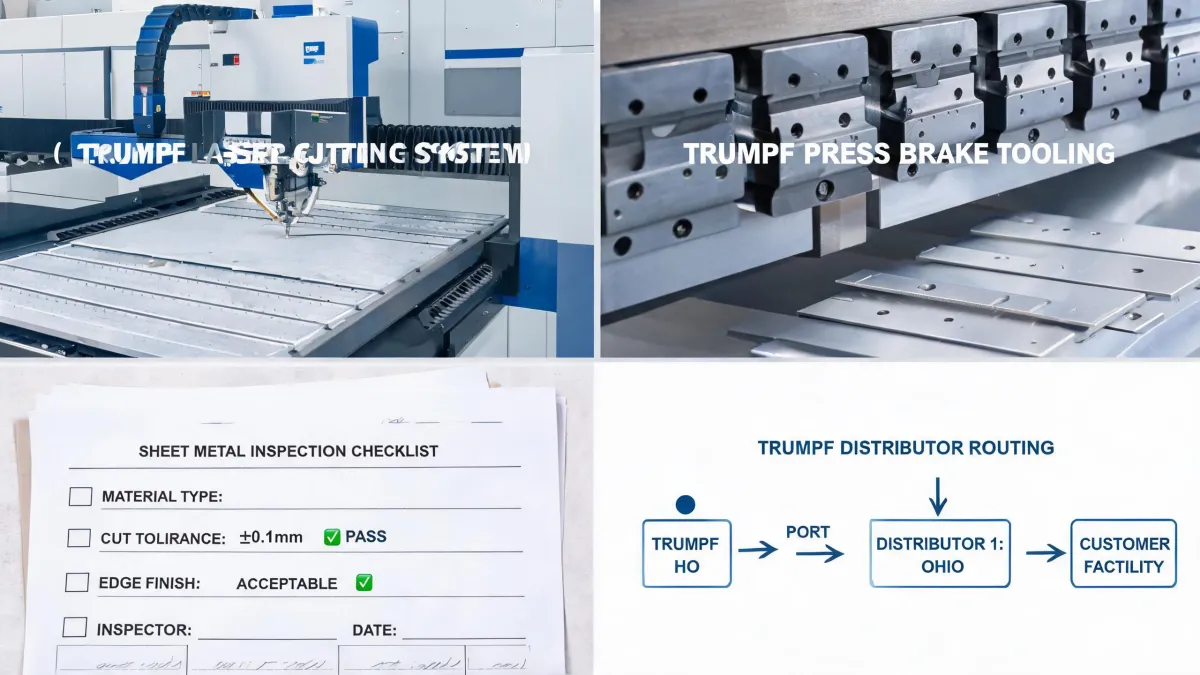
I've spent twelve years handling metal CNC machining orders, and I've made enough mistakes to fill a small binder. The biggest one happened in 2021, when I almost sold our TRUMPF CO2 laser for scrap after one impressive TRUMPF fiber laser demo. The demo was true. It was also useless. Here's the part nobody tells you: the machine isn't the strategy. The part mix is.
The Surface Problem: “Fiber Is Better” Isn’t a Plan
Every month, someone from a metal CNC machining factory asks a version of the same question: “Should we replace our CO2 with a fiber?” Usually they've just watched a 12 kW fiber laser cut 1 mm stainless like it was paper. The numbers look undeniable. Then they look at our old CO2 machine and wonder why we still haven't thrown it out.
The answer is that “better” means better for a specific part. TRUMPF fiber lasers are amazing for thin sheet. A CO2 laser still has a real place for thick plate and edge-critical work. The moment you treat a laser purchase as an upgrade instead of a tool decision, you're setting yourself up for the same mistake I made.
Why We Kept a TRUMPF CO2 Laser: The Deep Reason
The deep reason isn't nostalgia. It's wavelength and edge quality.
TRUMPF CO2 lasers run at 10.6 micrometers. TRUMPF fiber lasers run around 1.06 micrometers. The shorter wavelength is absorbed more readily by metal, which is why fiber machines dominate thin-sheet cutting. But when you cut thicker plate on a fiber laser, the edge can behave differently. I don't have hard data on industry-wide acceptance of fiber-cut thick plate. What I can say from our floor is that a clean weld-ready edge is not automatic.
Our CO2 ran circles around the fiber on a job with 20 mm plate and strict squareness requirements. The fiber cut it, technically. The edge had dross and slight taper. The customer would have rejected every single piece. That's when I stopped looking at marketing charts and started looking at cross-sections.
Honestly, I'm not sure why some shops seem to get clean thick-plate edges from a fiber laser without issue. My best guess is they're running much higher power and different gas mixes than we were. If someone has a proven recipe, I'd love to hear it. But I'm not selling the CO2 until I can reproduce it.
Maintenance is part of the story, too. A CO2 laser needs resonator gas, mirrors, and regular alignment. A fiber laser is simpler in some ways, which makes its operating cost look better on thin sheet. But when you're running a general-purpose shop, the cheapest hour isn't always the cheapest part. If the edge needs rework, the hour wasn't cheap at all.
The $47,000 Mistake That Changed My Checklist
In September 2022, I took a rush order for 42 steel brackets. 20 mm plate, six different hole patterns, weld-ready edges. I was determined to prove the new fiber laser was the right machine. So I ran the first batch on it. My lead operator asked if I was sure. I said yes. I still think about that answer.
The first few brackets looked fine until fit-up. The 12 mm slotted holes had to align with a mating flange. The fiber-cut edge had a slight taper, and the slots were not perpendicular enough for the weld fixture. On eight parts, it didn't matter. On 34 parts, it did. We re-cut 34 brackets on the CO2, paid overtime, and ate $9,200 in labor plus $1,400 in gas. The customer didn't reject the order, but they sure remembered it during the next quote.
When I added the machine time, lost production, and the discount I gave to keep the relationship, it went past $47,000. That was the cost of answering a capability question with a spreadsheet. A capability demo told me what the machine could do. It didn't tell me what it could do on our parts.
The numbers said fiber. My gut said keep the CO2. I went against my gut because the ROI model looked so clean. Even after approving the purchase order, I kept second-guessing. What if I'd just bought a very expensive thin-sheet machine? The two weeks before installation were stressful.
A few months later, I got a message that started, “Cory Reamer Alabama here. Would a TRUMPF fiber laser be a mistake for our shop?” That was a better question than “which machine is better?” It wasn't about capability. It was about fit.
What Is Metal Additive Manufacturing?
I get asked “what is metal additive manufacturing?” a lot, mostly by people who assume it's the next step after laser cutting. It's not. It's a layer-by-layer method: powder or wire is melted and fused, using a laser or electron beam, until a part is built from the ground up. TRUMPF calls its powder-bed systems the TruPrint series. They're not magic boxes. They're heat-management problems with a part growing inside.
If you're running a metal CNC machining factory, additive deserves a specific question: does this part have geometry that's impossible or painfully expensive to machine? If the answer is no, additive is probably the wrong answer for that part. That's not what people want to hear from a technology blog, but the part mix decides here too.
I once watched a company almost buy an additive machine for a bracket that could be laser-cut in four seconds. The bracket was not the problem. The excitement was. That's why I keep telling people to start with the part, not the machine.
The Short Version: What I'd Do Differently
If I had to do it again, I'd ignore the machine specs until I knew the part mix. A lot of metal CNC machining factories don't have that data at the front of a buying conversation. Here's the checklist I use now:
- Sort your last 12 months of orders by material, thickness, and edge requirement. A pie chart of your part mix tells you more than any demo.
- Run your own production file on a candidate machine. Not a nice test piece. A messy, hard, half-supported real part.
- Calculate total cost per part. Laser time, gas, electricity, consumables, and secondary cleaning. The cheapest machine can lose on gas.
- Keep the TRUMPF CO2 laser if thick-plate or weld-ready edges are a regular part of your mix. It doesn't need to run all day to be worth keeping.
- For additive, start with design reviews, not machine demos. The geometry should justify itself before anyone quotes a build time.
Before anyone buys, I tell them to get a part test at TRUMPF's application center. Not a demo part. A real part from their own reject bin.
As of January 2025, our shop runs both. The fiber machine handles thin aluminum and stainless. The TRUMPF CO2 handles thick plate and the jobs that need a square edge. I'm glad I didn't sell it. But I'd be lying if I said we planned that from the start.
Bottom line: The problem was never the laser. It was the way I asked the question. Instead of “which machine is better?”, I should have asked “which parts do we hate cutting today?” That would have saved me $47,000, a rough two weeks, and a lot of unnecessary stress.