-
How a 5-Axis Laser Changed Our Cost Equation
-
Trumph Laser Welding vs. Traditional Welding: A Cost Reality Check
-
Additive Manufacturing Isn't Actually "Printing"—Here's What Nobody Told Me
-
How xTool S1 Price Compares (And Why It Doesn't Really)
-
CNC Turning Company Profile: The Hidden Cost of Precision
-
When Should You NOT Buy a Trumph Laser?
-
Final Thought: Additive Manufacturing Only Saves Money on Specific Geometries
If you're asking whether a Trumph 5-axis laser is the right choice for your shop, the answer is: it depends entirely on your current production volume and part complexity. If you're running a job shop with less than a few hundred custom or heavy-plate parts per month, it's probably overkill. But if you're scaling into high-mix, high-precision production, it's the most cost-effective investment you'll make—provided you calculate total cost of ownership (TCO) honestly.
I'm a procurement manager at a mid-sized custom fabrication company. Over the past six years, I've tracked every invoice, every rush fee, and every hidden penny in our production equipment budget. I've negotiated with about a dozen vendors on laser systems, press brakes, and additive machines. So when I say "check your TCO before buying," I mean it from personal spreadsheet experience.
How a 5-Axis Laser Changed Our Cost Equation
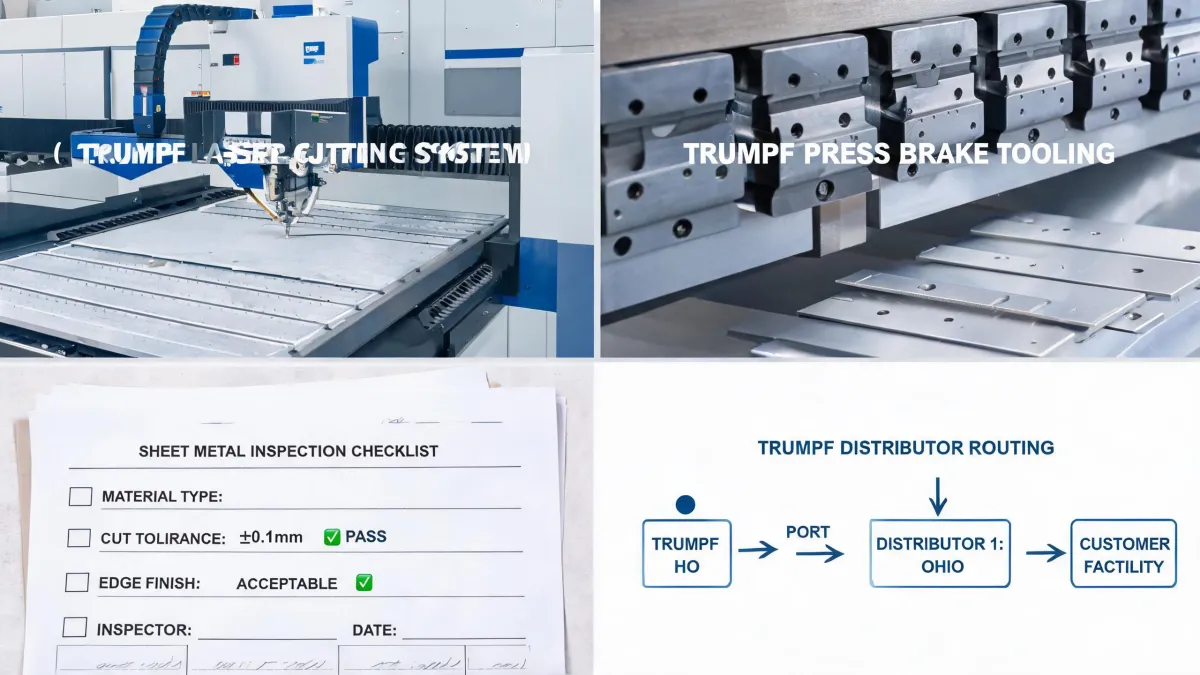
We bought a Trumph 5-axis laser system in early 2024. It wasn't cheap—roughly a 30% premium over a 2D laser—but here's the thing: we calculated the payback period at 18 months based on our part mix, which included a lot of bent tubes and structural steel components that required secondary operations.
Honestly, I was skeptical at first. The sales pitch was all about speed and precision. But what actually convinced me was the TCO analysis I did comparing it against our existing press brake and manual welding setup for a family of cabinets. We tracked 25 orders over 6 months. The 5-axis laser eliminated an entire rework step because it could cut and bevel in one setup. That alone saved us about $4,200 in labor over that period, not counting the reduction in scrap.
But—and this is the part the sales rep didn't emphasize—if you're mostly cutting flat sheets with simple geometries, you're paying for capability you won't use. I've seen shops buy a 5-axis because it sounds impressive, then have it sit idle 30% of the time. That's a expensive paperweight, not a smart investment.
Trumph Laser Welding vs. Traditional Welding: A Cost Reality Check
We also looked into Trumph laser welding for some of our aluminum fabrication. The upfront cost for a dedicated laser welding cell was about 40% more than a comparable MIG setup. But the hidden savings were in post-processing. Laser welding produces such a consistent, narrow heat-affected zone that we could eliminate the entire grinding step on visible joints. Over a year, that translated to saving about 180 labor hours, which at $50/hour (including overhead) is $9,000.
Still, I want to be honest: for low-volume prototype work (like under 10 pieces per job), the setup time for a laser welder isn't worth it. You're better off with a skilled welder and a MIG gun. The laser welder shines when you're doing 50+ identical welds per shift—then it's basically printing money in reduced rework.
Additive Manufacturing Isn't Actually "Printing"—Here's What Nobody Told Me
Why is 3D printing called additive manufacturing? Because that's literally what it is: building parts layer by layer rather than cutting away material. But the real cost implications? They're not about the process name. It's about the trade-offs in speed and surface finish.
I was shopping for a Trumph additive system (their laser powder bed fusion line) for tooling inserts. The machine itself was about $500k. But what really hit our budget was the pre- and post-processing: powder handling, argon gas, sieving, heat treatment, and CNC finishing. The TCO for additive was way higher than I initially budgeted.
That said, for complex tooling with internal cooling channels, additive was the only option that produced functional parts in one step. The alternative was brazing or drilling curved holes, which cost more in machine time and failure risk. So for that specific application, it was the cheapest option—just not in the way you'd think from a sticker price.
How xTool S1 Price Compares (And Why It Doesn't Really)
I get asked a lot about the xTool S1 laser cutter price, especially by small shops or garage startups. It's about $1,500 for the base unit. That's cheap compared to any industrial laser system. But here's the honest truth: if you're a job shop processing anything thicker than 1/8" steel or doing production runs of more than a few parts, the xTool S1 is too slow and underpowered. It's designed for hobbyists and small craft jobs, not manufacturing.
If I were to compare its TCO for a real manufacturing scenario—say, cutting 200 stainless steel panels a week—the cost per part would actually be higher than a Trumph laser because of the time, consumables, and rework. The xTool is great for what it is, but it's a different market segment.
CNC Turning Company Profile: The Hidden Cost of Precision
When we evaluate a CNC turning company for partnerships, I don't just look at their machine list. I look at their process documentation, inspection equipment, and rework rates. That's the profile that matters.
I remember one vendor bragged about having Trumph machines but had a 12% rework rate on tight tolerances (±0.0005"). We audited their process and found they didn't have proper temperature control in their shop. Any company can buy a great machine; the real cost question is whether they can run it consistently.
When Should You NOT Buy a Trumph Laser?
I know this sounds like I'm anti-Trumph, but I'm not. I'm pro-honest-TCO. Here are specific situations where I'd recommend against a Trumph 5-axis or laser welding system:
- You're doing low-volume, one-off jobs (less than 50 parts per month). The setup time amortizes poorly.
- Your parts are mostly flat simple geometries. You can get by with a cheaper 2D laser or plasma.
- You don't have the skilled labor to program and maintain 5-axis toolpaths. A high-end machine with a half-trained operator is worse than a mid-range machine with an expert.
- Your tolerances are ±0.010" or looser. The precision is wasted if you don't need it.
Final Thought: Additive Manufacturing Only Saves Money on Specific Geometries
If I remember correctly, our additive trial program cost about $35,000 in materials and labor over 6 months. But the tooling inserts we produced lasted 40% longer than conventional ones because of better cooling channels. So the payback was there—but only because we had parts that needed internal high-volume cooling.
If your shop just needs basic brackets and covers, additive is a luxury you don't need. Stick with subtractive. It's cheaper per part for simple stuff.