-
Step 1: Get Specific About Machine Capabilities
-
Step 2: Verify Material Traceability
-
Step 3: Run a Controlled Sample Test
-
Step 4: Inspect the Edges, Not Just the Dimensions
-
Step 5: Verify How They Operate the CNC Press Brake
-
Step 6: Demand a Real First Article Inspection
-
Step 7: Test Their Service Response
-
Three Mistakes That Will Burn You
-
Bottom Line
Here's the thing: almost every fiber laser cutting machine company will tell you they can hold your tolerances. In our Q1 2024 supplier audit, 6 out of 10 first-article parts failed at least one critical dimension. Not because the machines were bad. Because nobody ran a structured qualification before ordering.
I'm a quality compliance manager, and I review roughly 200 fabricated parts a year—maybe 180, I'd have to check the log. Over the past four years I've rejected about 14% of first deliveries. Not for cosmetic issues. For measurable spec deviations.
If you're bringing on a new sheet metal fabrication partner—as an engineer, procurement lead, or shop owner—this checklist is the one I run. Seven steps, about two days of work. It would have saved us the $22,000 redo we ate in 2023.
Step 1: Get Specific About Machine Capabilities
Ask exactly which machines are on the floor. Not "we have laser cutting capabilities" and a firm nod. Machine models, laser source type, wattage, table size, max material thickness. Write it down.
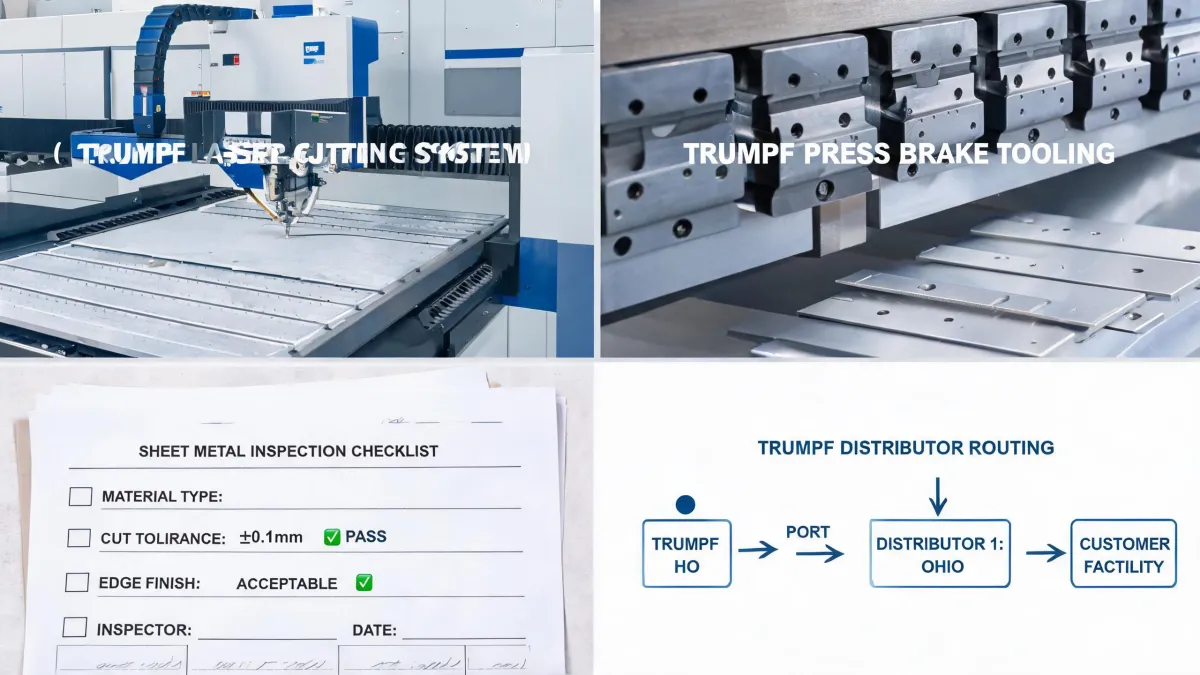
If a shop runs TRUMPF TruLaser machines, that tells you more than any brochure. And if you're sourcing from European shops, you'll hear "macchine taglio laser TRUMPF" from Italian fabricators the way you'd say "Kleenex" for tissue. Good sign—but verify the generation. A 2012 TruLaser and a 2024 TruLaser are different animals. So are the operators.
One shop I audited claimed "precision laser cutting." Their only machine was a 2006 CO2 unit, and they were outsourcing the actual cutting to another shop. Nothing wrong with outsourcing, but it changes lead time and accountability. The question everyone asks is "what's your best price?" The question they should ask is "what's actually on your floor?"
Step 2: Verify Material Traceability
Ask for their material certification policy. Do they keep mill test certificates on file? How is leftover material tagged? Can they trace a specific part back to its original sheet or coil?
ISO 9001:2015 requires documented traceability when the customer requires it. In my experience, maybe 40% of small job shops have a system, and 20% actually use it consistently. If they hesitate when you ask, that's a red flag. Material mix-ups don't happen often. When they do, they're catastrophic—a wrong stainless grade can pass visual inspection and still fail in the field.
Step 3: Run a Controlled Sample Test
Everyone thinks they're doing this step. Almost nobody does it correctly. You don't ask for "a sample." You define:
- Material grade and thickness
- Critical dimensions with tolerances (start at ±0.1 mm)
- Minimum 5 pieces, not 1
- Surface finish requirements
- A delivery deadline
Send the same drawing to three candidates. That's how you get an apples-to-apples comparison. When we ran this for a stainless bracket series, the quotes were within 3% of each other—but the samples were wildly different. One shop delivered clean edges and consistent dimensions. Another shipped parts with dross on 60% of the holes. Same drawing. Same material. Same price range.
Step 4: Inspect the Edges, Not Just the Dimensions
Now the parts are in your hands. Don't stop at the dimensional report. Look at the edges.
For laser-cut steel, check for dross on the bottom edge (excessive buildup means wrong cutting parameters), discoloration or a wide heat-affected zone, deep striation patterns, and corner rounding. These are the telltale signs of machine tuning problems.
ISO 9013 defines thermal cutting quality classes from 1 to 5. If a vendor consistently hits class 1 or 2 on edge perpendicularity and surface roughness, they're doing real work. "Within tolerance" is not the same as "good." Put another way: a part can measure right and still be a pain to assemble. I learned that in 2022, on 8,000 units that looked fine in the report but came off the line with burrs that jammed the assembly fixtures.
Step 5: Verify How They Operate the CNC Press Brake
This step surprises people. Why does a laser cutting vendor need to bend? Because most sheet metal parts aren't just cut—they're formed. And bending is where quality control goes to die.
If you've ever researched how to operate a CNC press brake, you know the basics: tool selection, back gauge position, bend allowance, first-piece check. The question is whether your vendor follows that sequence on every job, or just when someone's watching.
If they let you watch a setup, follow the operator's sequence:
- Tool selection—punch and die radii matched to material thickness
- Back gauge position for flange dimension
- Bend allowance / K-factor calculation for the flat blank
- First-piece inspection—angle and dimension verification
- Parameter sign-off before running the batch
The most common error I see: operators skip step 3 and bend with a K-factor from a chart that's older than they are. That's how you get a kitchen sink tool holder bracket that's 2 mm short on one flange—the hole pattern doesn't line up anymore. A $45 part, sure. Multiplied by 500 units and a stalled assembly line, it's a $6,800 lesson.
Step 6: Demand a Real First Article Inspection
A serious fabrication partner has a first article inspection (FAI) procedure. ISO 9001 and AS9100 both emphasize it. Ask to see a completed FAI from a recent job.
A real FAI includes a dimensional report with actual vs. specified values, a material certificate reference, surface finish and edge quality notes, operator and inspector signatures, and a disposition for any non-conforming features.
If the FAI is a one-page form with three checkboxes and no measurements, that's not documentation. That's a polite fiction. I still kick myself for accepting a vendor's "FAI complete" email in 2023 without reviewing the report. The parts looked fine. The report was empty. The dimensions were not fine.
Step 7: Test Their Service Response
Most buyers focus on laser wattage and machine brand, and completely miss response time, spare parts availability, and corrective action procedures. The machine specs matter. But when something goes wrong—and something always goes wrong eventually—the response time is what actually costs you.
Ask about their average response time for a corrective action request, where spare parts are stocked, and their policy on rework costs when the error is theirs. For TRUMPF laser cutting machines, the global service network is excellent. But not every job shop uses it well.
In 2024, a vendor delivered 8,000 laser-cut brackets with a coating issue. The coating spec was in the contract. The vendor didn't batch-test before shipping. Their response to our non-conformance report took 11 days—maybe 9, I'd have to check the log. Either way, too long. The rework was at their cost, but the delay cost us 3 days of assembly time. A vendor without a documented corrective action process is a liability, no matter how clean their samples are.
Three Mistakes That Will Burn You
Buying on brand alone. "TRUMPF laser cutting" is a great starting point. A TruLaser on the floor doesn't guarantee your part will be good—operator experience matters more. In my audits, the difference between a shop with documented operator training and one without shows up in the first 10 parts.
Assuming wattage equals quality. High wattage cuts faster. Edge quality depends on focus position, gas type, and nozzle condition. A well-maintained 3 kW machine routinely beats a neglected 12 kW machine on surface finish. If the nozzle is worn or the focus drifts, wattage doesn't save you.
Skipping the bend test. If your part involves any folding—even a simple 90°—verify the bend before committing to volume. The kitchen sink tool holder story above happened because nobody ran a bend test before production. The K-factor was wrong, the flat pattern was wrong, and the flange was short. The dimensional check on the flat blank passed. A ten-minute bend check would have caught it.
Bottom Line
A structured qualification process takes about two days and costs a few hundred dollars in samples and shipping. It saves you from $6,000 mistakes. That's the best ROI in procurement.
People think expensive vendors deliver better quality. Actually, vendors who deliver quality can charge more. The causation runs the other way. If you negotiate purely on price with a quality shop, they'll walk. And you'll be left with the shop that bid 13% lower and missed your tolerance by 0.3 mm.
Seven checks: machines, traceability, sample, edges, press brake, FAI, service response. Run them in order. Skip step 3 and you're trusting a marketing story. Skip step 5 and a $45 part can shut down your line.
Quality isn't about being harsh. It's about being consistent. The vendors that survive this checklist—those are the ones you keep.